Showing posts with label Reunion Island. Show all posts

Thursday, 31 July 2025

Sainte-Marie Cultural Heritage Trail

I recently provided the English voiceover for the historic town centre cultural heritage trail ("Parcours Centre-Ville Historique") of Sainte-Marie, the town where I live in Reunion.

Like many places in Reunion, Sainte-Marie has a blend of maritime history, Creole culture, and architectural legacy. The town council has installed several information points where you can scan a QR code and listen in English, French or Reunion Creole to learn more about where you are and what you're seeing.

Each of the eight audio segments I recorded lasts a few minutes, and uses a musical background to transport the listener back in time. 

You can listen to them below, or walk the heritage circuit yourself if you're visiting Sainte-Marie, to find out more about the:
  • Coastal battery & shipwrecks: learn about Sainte-Marie's maritime past 
  • Railway station: trains stopped at Sainte-Marie from 1882 to 1963
  • Local figures: find out more about Noel Tessier, who married Anne Mousse (the first woman born on Reunion); and Augustin Panon, whose nickname "the carpenter" was given to the Ravine Charpentier river gully
  • Sainte-Marie parish and cemetery: discover what is different about this cemetery from any other on the island
  • Town Hall (Hôtel de Ville): built in 1860, it has survived major cyclones


map of the Heritage Trail (not all stops have audio segments)


The coastal battery ("3" on the map):


Shipwrecks off the coast of Sainte-Marie ("1" on the map):


Train station ("2" on the map):


Noel Tessier (married to Anne Mousse, whose statue is "6" on the map):


Cemetery ("7" on the map):


Parish church ("8" on the map):


Town Hall ("15" on the map):


Augustin Panon, nicknamed the carpenter:


 You can explore the full audio trail on the Sainte-Marie official municipal website (in French).

Have you listened to the tour or walked the trail yet? Let me know your thoughts in the comments below.

More about Sainte-Marie:

Tuesday, 15 October 2024

There's a Monster behind the Door: author interview

Having read Un monstre est là, derrière la porte when it came out, I was delighted to read its English translation, There's a Monster behind the Door, as it's the first novel from Reunion Island to have been professionally translated and independently published in English. It's been beautifully translated by Karen Fleetwood and Laetitia Saint-Loubert, and I enjoyed reading the translation as much - if not more - than the original.

More than just a novel, There's a Monster behind the Door is a window into the heart and soul of Reunion Island, and its publication in English marks a significant milestone for the island's literary scene. In this exclusive interview, which I've translated myself from the French, author Gaelle Belem discusses the impact of the translation, the motivations for her writing, and her hopes for the book's reception. She also offers an insight into her creative process, the contribution she would like to make, her commitment to Reunion, and her belief in the power of literature to connect and inspire.

cover of There's a Monster behind the Door

There's a Monster behind the Door is the first novel from Reunion Island to be translated into English. How does it feel to see it published? Has it changed your perspective on your own work? Do you have any specific fears or expectations about it?

I'm not proud that my novel has been published in English; I'm proud that literature from Reunion is finally being exported. I still have the same doubts and worries about my writing. For me, the most important thing, more than any kind of recognition, is to help people understand the complexity of Reunion and to portray it as accurately as possible.

Were you involved in the translation process? If so, how? Have you read the translation, and what are your thoughts on it?

While the book was being translated there were several email exchanges and a meeting in Paris between one of the translators, Laetitia Saint-Loubert, and myself. Overall, both translators, Karen Fleetwood and Laetitia, worked completely independently, with my full faith. Laetitia has lived and taught in Reunion, and is a specialist in translating books from the Caribbean and Indian Ocean. Her experience and skills explain why I intervened very rarely, and then only to clarify the meaning of a Reunion Creole word or expression.

I think their translation is excellent. They have fully preserved the letter and spirit of the original text.

Laetitia and Karen have earned my eternal gratitude and respect.

What initially inspired you to write There's a Monster behind the Door, your first published novel? How did the idea come about - through a particular event or personal experience? Were there any specific references or authors who influenced its creation?

The book was always there, in the making. I just had to look around me, read the newspapers, and listen to the people of Reunion to get the idea for this book. It was crucial for me to give a voice and visibility to those who have very little.

As a writer, my inspiration is wide ranging and doesn't come from literature alone. While the realism of Zola and Maupassant formed my literary foundation, the stylised violence of a Park Chan-Wook or Tarantino film, or the music of [local band] Ousanouva added colour to my debut novel.

Gaëlle Belem

Was there a message you sought to convey with your novel, especially to those discovering Reunion Island for the first time through the English translation? Do you have any expectations or a particular readership you wanted to reach?

I have an unconditional love for my readers, whoever they may be, and for whom my novels are intended to be ambassadors of Reunion. Every page reminds us that the island is a fabulous, multilayered melting pot – a juxtaposition of sublime landscapes, tolerant and mixed-race communities as well as varied food; however it also has its dark side, its poorly healed wounds, and the stigmata of violent colonialism.

There's a Monster behind the Door seems to be deeply rooted in Reunion. Do you think it could resonate with an international audience, despite these cultural specifics? Are there any cultural aspects that you hope to convey more than others through this translation? What do you want English-speaking readers to understand about the island and its social realities with your book? In your novel, you often paint a bleak picture of Réunion. Was this a deliberate attempt to counter the idyllic image we might have of the island, or was it a narrative necessity to explore the psychological depths of your characters?

I have no problem with horror. Reunion Island has no shortage of it. "So what?" I'd like to say. Every paradise has its serpent.

Reunion is a mixed tropical paradise, fraught with violence, multiple historical traumas and a highly ambiguous relationship of dependence-inferiority complex-hate-dream of emancipation with regard to mainland France. It's a land of mountains and paradoxes! The island is undoubtedly the most beautiful in the world, but its history is definitely not! A novel is an open conversation with the reader. In this clear, uncompromising conversation, I wanted to express the beauty and ugliness of the island, yet always with humour and a deep affection for the characters.

Do you believe that literature contributes to a better understanding of Reunionese culture?

Yes, I do. Literature is the screen through which we can view the people and their way of life. In a world where travel is increasingly criticised for its high carbon footprint, literature allows us to explore history, places, and the psyche of individuals. Reading about Reunion provides an opportunity to do just that.

cover of original novel in French

What are your future writing projects? Does the possibility of expanding your readership through translation influence your approach to these future projects?

Writing is not a project. It's a way of life, a permanent trance. Even when I don't have a pen or keyboard in front of me, I'm nothing but scribbles and writing in my mind. Beyond writing, what truly matters to me is to serve Reunion through a humanist and socially responsible approach. To project oneself means being useful to others. If my books make this possible, so much the better. Now we just have to open the door wide and let the monster jump out. 

There's a Monster behind the Door was published on 10th October by new independent Irish publisher Bullaun Press. Many thanks to them for the review copy.


Further reading:

Sunday, 3 January 2021

Domaine de la Roseraye, Ste-Rose

Domaine de la Roseraye is a small former sugar factory in Sainte-Rose, on Reunion's south-east coast. We were some of the first people to visit it as part of a new series of guided tours organised by Les Aventuriers de l'Est in partnership with the site's owners, the Adam De Villiers family.


The site has belonged the Adam De Villiers family since the turn of the last century, but the former sugar factory ruins left there predate them and are probably mid-nineteenth century. 


The remains include an (incomplete) boiler, a broken flywheel, and a small sugar cane mill. They are interesting because Domaine de la Roseraye is one of the few, if not the only, factory sites on Reunion that has been left virtually as it was. Its small size is typical of properties of the time, and it's a piece in the jigsaw puzzle of the island's sugar cane industry development.


Incidentally until the late 19th century the only way to reach Ste-Rose from the north and east was by sea. The bridge over the Rivière de l'Est - the world's longest at the time - was only built in 1894.


The family had some archaeological work carried out between 2015 and 2018 but frustratingly French regulations mean that if there is no active archaeological research being carried out the site has to be recovered in order to preserve what's underneath. Prior to 2015 it was a guest house, with rooms in the converted stables. The actual house is quite unprepossessing and was apparently never lived in full-time. Located in such a backwater it didn't need the bling-bling of houses such as those on St-Denis' Rue de Paris for example.

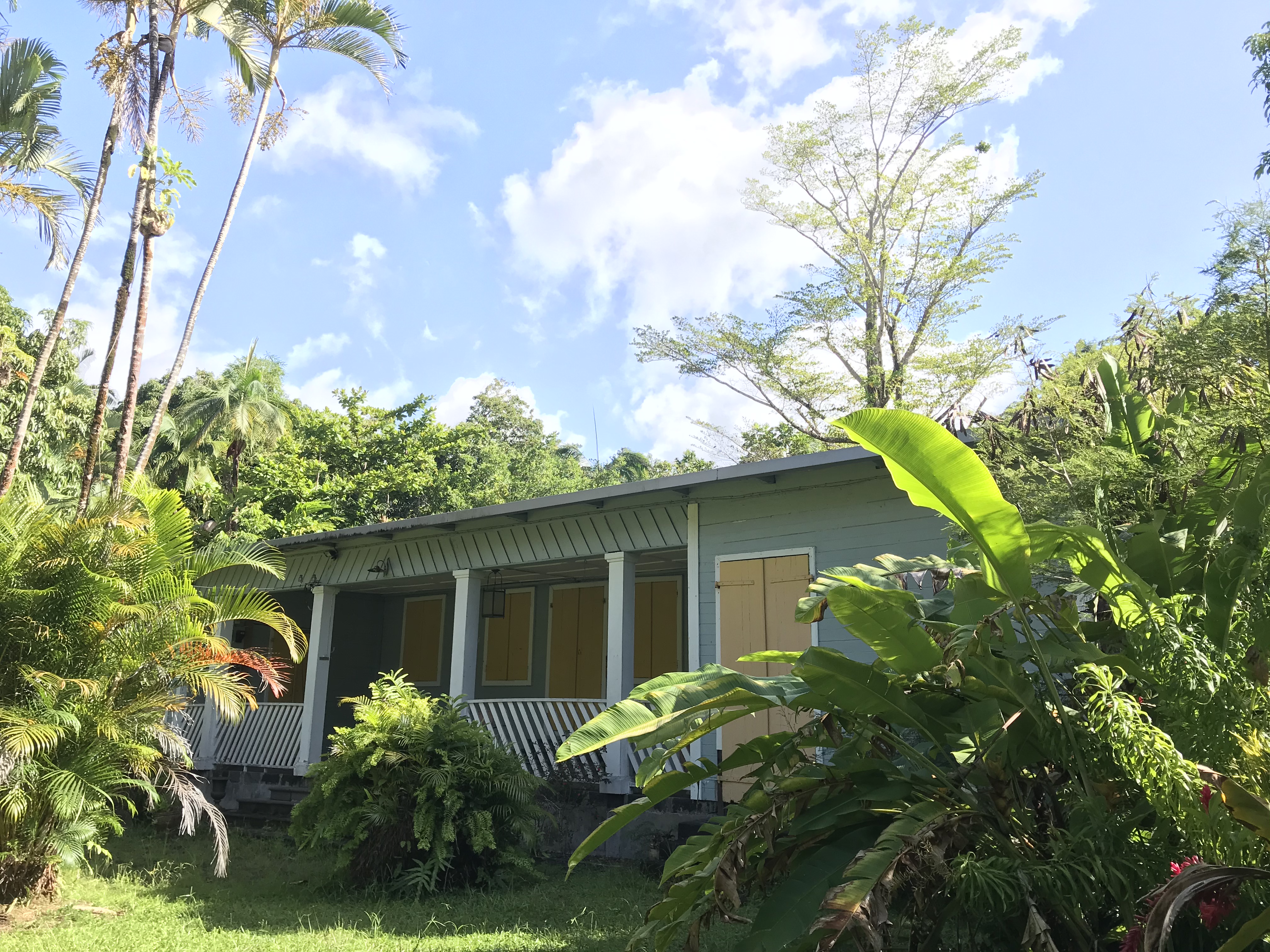
house at Domaine de la Roseraye

verandah of the house at Domaine de la Roseraye

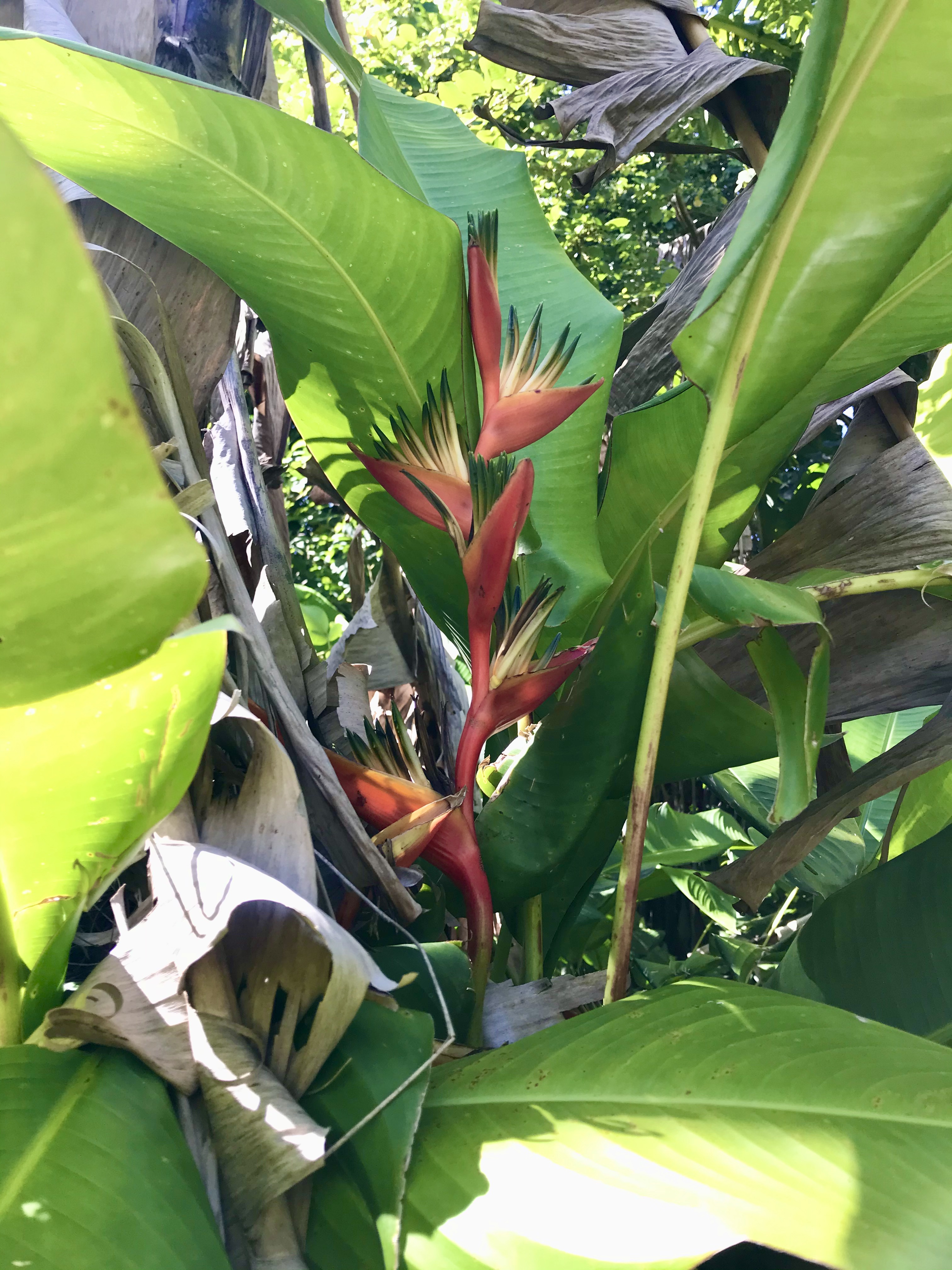
Whoever planted the garden must have loved Heliconias, as I've rarely seen so many different varieties in one place!


Heliconia rostrata


Heliconia chartacea

There were also plenty of other plants and trees in the garden. As Ste-Rose is located on Reunion's windward coast it gets lots of rain, which means gardens in the area are extremely lush.

starfruit flowers

Lipstick palm (Cyrtostachys renda)


Incidentally a TV journalist was there at the same time as us, and her news segment can be seen here:

Domaine de la Roseraye guided visits take place on the 1st Sunday of every month and you should contact Les Aventuriers de l'Est at aventuriersdelest@gmail.fr or 0692 34 45 21 to book. Visits for 15 or more people can be organised on other dates.

See also:

Sunday, 6 December 2020

Cascade Blanche

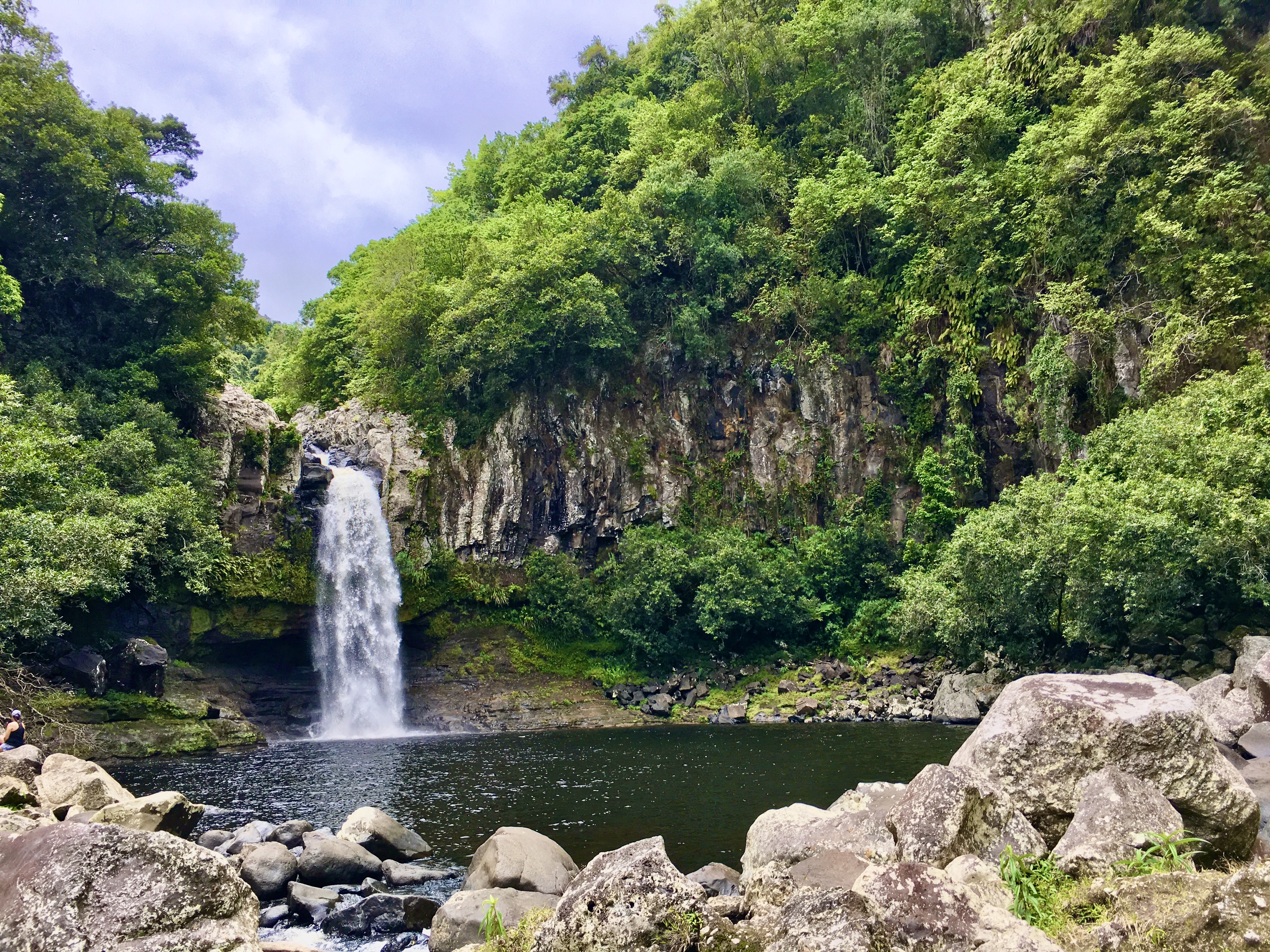
Falling 640 metres, Cascade Blanche is one of France's highest waterfalls, and Reunion's third-highest (the tallest is Trou de Fer). Often associated with Salazie as it lies near the entrance to the cirque, in fact it technically falls within the municipality of Bras Panon. It's very visible on the drive in and out of Salazie cirque, although on the way in you have to look back over your shoulder just past Pisse en l'Air to see it.

Cascade Blanche

Getting to a good viewpoint just opposite the waterfall is a fairly easy 35-minute hike, although actually getting to the foot of the waterfall is a little more "athletic" (it involves fording a river, wading through muddy channels, and clambering over large boulders).

sign near the start of the hike

Forestry Commission sign at start of hike,
warning that part of the pathway is unstable

a species of Heliconia growing wild

part of path

sign at the viewpoint marking the end of the maintained
path. While it doesn't forbid from going any further,
it warns hikers to watch out for flash floods in the river

view of Cascade Blanche from the viewpoint

After cooling our heels ankles in the river (called Bras de Caverne), we then made our way to the foot of the waterfall where we took a dip in the water before making our way back.


If you read/understand French you can find out more about the hike here:

view on the way back

See also:


Sunday, 29 November 2020

Rivière du Mât

Although I worked for 9 years at Bourbon Plastiques, I never hiked this path up alongside the Rivière du Mât river although I'd heard about. It's now been 12 years since I left BP to move to Seoul for three years, so when an outing to Rivière du Mât was suggested by a group of friends I was keen to participate.

Bourbon Plastiques roofs are just visible behind the vegetation

It's not a very difficult hike, and the path is flat most of the time. We only went as far as Bassin des Aigrettes, which should not be confused with its homonym at Saint-Gilles, although they do look similar.


At one point on the path a sign indicates Bassin De La Mer, which is a bit further on and slightly steeper to get to. Again this should not be confused with its near-homonym Bassin La Mer at Saint-Benoit.

sign to Bassin De La Mer

Bassin des Aigrettes, Rivière du Mât

The way back was by the same path, and we stopped off to cool our feet in the river.

Rivière du Mât, looking east towards the sea

The area near the carpark where the hike starts and finishes has been landscaped to a certain extent, and there are some attractive plants as well as some old remnants of the former sugar factory that Bourbon Plastiques stands on the site of.


jackfruit growing

Heliconia

ornamental banana

If you're interested in this hike, information in French can be found at La boucle des Bassins de la Mer et des Aigrettes depuis la Rivière du Mât.


See also: