We chose to arrive in
Lhasa by travelling on the world’s highest railway, a journey of breath-taking beauty that lasts 24 hours from the Chinese city of Xining, and crosses the
Tanggula Pass at 5072m. Arriving late at night, we were greeted by our guide in Lhasa with khatags, the white silk ceremonial scarf that is commonly given in Tibet as a sign of welcome. This was the first of many khatags we received.
 |
| Tibetan Landscape |
Lhasa literally means "The abode of the gods" and hosts three very important religious sites : the
Barkhor, the
Potala Palace, and the
Jokhang Temple. The latter is the spiritual centre of Lhasa, and is the largest temple of
Tibetan Buddhism. Visiting the Jokhang is an unforgettable experience. Outside the temple are pilgrims performing thousands of ritual prostrations, some of whom have travelled hundreds of miles this way. Many wear leather aprons and kneepads fashioned from tires, and hold pieces of wood to help them slide more easily without injuring themselves, but it’s easy to recognise those who have come far by the marks on their forehead (it’s estimated that it takes about 70 000 successive prostrations to travel one hundred kilometres !). Inside the temple the acrid scent of yak butter lamps pervades the air with a distinctive rancid smell, very characteristic of Tibetan temples. The walls are blackened by centuries of lamp smoke, but it’s still possible to distinguish the striking paintings of bulging-eyed "wrathful deities" wearing garlands of severed heads. In the temple, which you have to move round clockwise, our companions were mainly small old ladies who walk while constantly turning a small handheld prayer wheel. In the street you frequently see Tibetans of all ages walking while turning a prayer wheel in one hand and holding a child or a bag of shopping in the other. They contain written mantras (prayers), and turning them supposedly releases the prayer into the air just as if it was being spoken.
 |
| Potala Palace from the Jokhang Temple |
The Jokhang is surrounded by the Barkhor, a fascinating maze of narrow streets, and the most popular circumambulation with Buddhist pilgrims and inhabitants of Lhasa. A little further is the famous Potala Palace: the primary residence of successive
Dalai Lamas until 1959. Composed of the white palace that was once the residence of the Dalai Lama, and the Red Palace, which was entirely devoted to religious study and prayer, it has 1000 rooms and houses 200 000 Buddhist images.

We left Lhasa after several days having acclimatised to the altitude (but not to the yak butter tea), and headed towards the base camp of
Mount Everest, stopping in Shigatse and
Xegar for more acclimatisation and sightseeing. En route we saw many yaks, and stocks of dried yak-dung (which is used as fuel), and we stopped at several passes of 5000m or more, generally adorned with colourful prayer flags fluttering in the wind. At one pass it was snowing – at the beginning of August ! At the base camp we were fortunate to have blue skies and only a few clouds, and so had a relatively good view of Qomolangma ("Goddess Mother of the Winds") as it’s known in Tibetan.
 |
| Mount Everest from the base camp |
Just after leaving the base camp we were lucky enough to have a private visit of the Nyingma Rongphu Monastery, the highest monastery in the world (altitude : 5100m), which is cut off from the outside world from December to March.
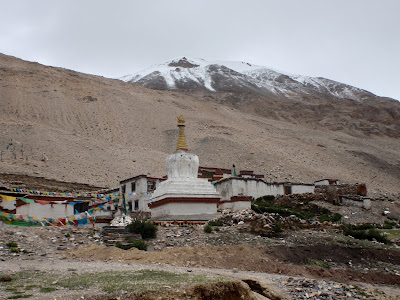 |
| Rongphu monastery |
Isolated and windswept, it seems to receive few visitors, and was guarded by a ferocious-looking
Tibetan mastiff. The towering peaks were surrounded by birds of prey that reminded us of the existence - ever present - of the Tibetan custom of sky burial. Practiced for over a thousand years this form of burial is the preferred choice of most Tibetans: the corpse is prepared by a specially trained monk and then left to the "holy birds". During the 1970s and 80s the custom was prohibited by the Chinese who regarded it as barbaric, however it has since been restored as it makes perfect sense in a land with few trees and little topsoil. For the Tibetans the dead body is nothing, only the spirit matters and it leaves the body at death.
 |
| Circle of Life of Tibetan Buddhism |
If you enjoyed this post you might also like:
Suggested reading :
- The Tibetan uprising - BBC Radio 4 programme about the shortlived battle for independence in 1959 against Chinese occupying forces.


