Showing posts with label Europe. Show all posts

Sunday, 29 May 2022

Dubrovnik & Montenegro

Another professional conference, this time in Montenegro, was the chance to make the most of being in Europe and fly from Portugal to Dubrovnik, the nearest airport to the conference location. This conference and the trip to Dubrovnik had actually all been planned (and paid for!) in 2020 when the pandemic hit. Everything eventually got refunded, but I was glad to finally make the trip, albeit two years later than planned. I'd been to northern Croatia (Zagreb and Rab) in 1991 when it was still part of Yugoslavia, but I'd never been to the southern part of the country.


Dubrovnik really is an extraordinary city to visit, and was definitely the highlight of a five-week five-country trip that also encompassed Portugal and Montenegro. We made the choice - a no-brainer in my opinion - to stay in the walled city itself so we could soak up as much of the atmosphere as possible.

our view at breakfast every morning 

On arrival we wandered around the compact city to get our bearings, before heading to one of the two bars clinging to the outer walls for a sunset drink. 

typical alleyway, our accommodation was down a similar alley

cliff-side bar, Dubrovnik

looking along the city's main street, Placa

The next morning we walked along the city's defining feature, its city walls. We took plenty of time, stopping to admire the view and take plenty of photos, so it took us about two hours to walk the 2 kilometres. You have to walk them in an anti-clockwise direction. 

view of Dubrovnik from the city walls


view of Dubrovnik port from the city walls

view looking west from the city walls

view south from the city walls

view looking north-west from the city walls


After what we felt was a well-earned lunch, we visited the Rector's Palace cultural history museum. This Gothic-Renaissance palace was built in the late 15th century for the elected Rector who governed Dubrovnik. For the one month that he governed, the Rector was unable to leave the building without the Senate's permission. The museum also houses a moving exhibition about Dubrovnik under siege in 1991-1992 (when you walk around the city, several walls have a map pinpointing damage from bombardments during the siege).
Former bell jacks (nicknamed Maro and Baro) made of bronze, and
cast around 1478. They struck the time for about 4 centuries

18th-century portrait, Rector's Palace

Column capital showing Asclepius (Greek god of medicine)
with Dubrovnik Cathedral dome in the background

To end the day, we then took the cable car up to Srđ to get a fantastic view of the city from a steep elevation of about 400 metres.

looking down onto Dubrovnik old city from Srđ
looking north from Srđ

On our final full day, we chose to take a boat trip to visit three of the 14 Elafiti islands that lie just off the north-west coast of Dubrovnik. The three we visited are the only islands that are permanently inhabited.

Kolocep is the nearest island to Dubrovnik and has a population of 163

with an area of 16 sq. km, Sipan is the largest Elafiti island

Lopud is car-free

Sign at our guest house. We didn't have time to visit Lokrum,
go the beach or go sea kayaking but we did most of the rest!
 
After three days in Dubrovnik, we headed south along the coast to Herceg Novi in Montenegro.

Dubrovnik seen when heading to Montenegro

We stayed in the hotel where my conference was taking place, located at Kumbor on the Bay of Kotor.

looking north from the hotel

sunset, Bay of Kotor

It was rather surprising to open your room curtains and realise a massive cruise ship was silently sailing past. They arrived in the morning and left at day's end.

cruise ship, Bay of Kotor

The next day we went on a boat trip to one of Montenegro's most famous sites, Perast and Our Lady of the Rock.

on our way to Perast ...

... being chased by a cruise ship

typical Montenegrin scenery 

St George's Island, which houses a monastery and can't be visited

Our Lady of the Rock is actually an artificial islet created by locals adding rocks after finding an icon of the Madonna on the original rock in the sea in 1452. It houses a church built in 1630 which has a small museum whose most famous exhibit is a tapestry of the Madonna partly made embroidered the hair of its maker (we weren't allowed to photograph it).

Our Lady of the Rock

the church on Our Lady of the Rock

close-up of the church on Our Lady of the Rock

inside our Lady of the Rock church 

inside our Lady of the Rock church 

Just across the water lies the attractive small town of Perast.

Perast

Perast from the water

I'll leave you with this (great) video from the conference, which has some great drone footage of the Bay of Kotor, and starts with a shot of Our Lady of the Rocks (you can see St George's Island just behind, and Perast to the left).


After four lovely days in Montenegro, it was time to head to Brighton for the third and final conference of my 2022 European tour!

You might also like:

Sunday, 29 July 2018

Tromsø and the Far North

On leaving Bergen we flew up to Tromsø, 70°N of the equator. This is the furthest north I'd ever been, as when we'd visited Iceland it's 'only' 65-65° north. As we were visiting in summer we were in the land of the midnight sun, and the week after we left the sun set for the first time in two months. Its latitude also means that from late November until late January the sun never rises, and Tromsø is apparently a great place to see the Northern Lights in winter.

notice what's missing?

Tromsø has a population of 75,000 and is the largest town in northern Norway.

Tromsø waterfront 

It's home to the world's most northernmost brewery, botanical garden, and cathedral. The building in the photo below is often referred to as a cathedral, but it's actually just a large parish church at Tromsdalen; Tromso's 'real' cathedral (the largest wooden cathedral in Norway) is located on the north side of Tromso bridge in the city centre. Tromsdalen church was built in 1965 and has eleven arching triangles that are supposed to suggest glacial crevasses and auroral curtains.

Arctic Cathedral/Tromsdalen Church

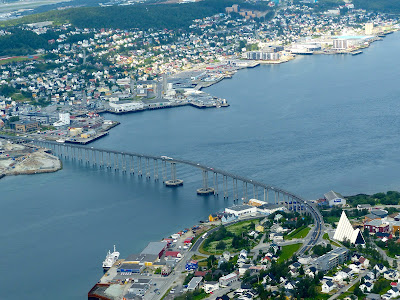
Tromsø is built on an island, Tromsøya, and the Arctic Cathedral is actually across a bridge, on the mainland.

looking north at Tromsø city centre from the Arctic Cathedral

Afterwards we took Fjellheisen cable car up to Mount Storsteinen (421m), from where there are good views.

panoramic of Tromsø and the island it's located on, Tromsøya

the bridge connecting Tromsøya with the mainland; cathedral is bottom right

looking east from Storsteinen, across the area known as Tromsdalen

The next day we hired a car for one day (just like in Bergen it was eyewateringly expensive, but at least this time we got upgraded!) and went to visit Senja, Norway's second largest island (not counting the Svalbard archipelago). Unfortunately unlike the previous and following day it was cloudy, but we still saw breathtakingly beautiful landscapes (although I feel the photos doesn't do it justice). Only about 10km out of Tromsø we came across a group of reindeer by the side of the road. We stopped to take some photos but didn't want to spend too much time because we had a ferry to Senja to catch (the next ferry was only 5 hours later!), and thought that in any case we'd see more reindeer elsewhere. But in the end these were the only ones we saw (alive, as we saw reindeer meat on menus at several occasions!).

one of the reindeer we saw

The village of Husøy sits on a small flat island in Øyfjorden, Senja

Ersfjorden and surrounding mountains, Senja 

Bergsfjorden contains 98 small islets 

Bergsfjorden, Senja 

Gryllefjord, Senja

fish drying outside, Senja

Norway is a land of tunnels (apparently the joke goes that if Everest was in Norway they would have dug a tunnel underneath it), and we saw many during our Senja roadtrip. As some of these could be quite narrow the local municipality has put in place a system of hi-viz vests for cyclists.

one of Norway's many tunnels

A box containing vests is placed at the entrance, and you can borrow one to ride through the tunnel. You then put it back in another box on the other side. A simple but effective system.

hi-viz vest (placed on box for the photo)

close-up of the vest,
reminding drivers to keep their distance 

Talking about bikes, on our final day full day in Tromsø we chose to hire electric ones, and cycled about 26km almost all the way round Tromsøya island, in a clockwise direction.


panoramic looking west from Tromsøya

looking west-north-west from Tromsøya

looking north, from Hamna

We stopped for a picnic lunch beside Prestvannet (known as Báhpajávri in the local Sami language), which is a small lake at the highest point on the central part of Tromsøya. The surrounding area is criss-crossed by paths used for recreational purposes (walking, running, cycling in summer, and cross-country skiing in winter).

our view during our picnic lunch beside Prestvannet

Not far away are the world's most northerly ski jumps. This is the vertigo-inducing view looking down.

looking down

 And this is the view looking up.

looking up at the ski jumps, Tromsø

We had time for a last cycle on the morning before we left Tromsø, and this time headed to Tromsdalen, crossing the bridge on our bikes to get there. As it was a Sunday morning everything was very quiet. At one point in the forest I saw a pair of skis propped up against a tree, and to me this is typical of the Norwegian attitude: everywhere we went lost objects were not stolen, but left in a prominent place to be recovered by their owners.

skis waiting for their owner to find them again?

Then it was time to head back to Oslo for less than 24 hours, before leaving Norway and carrying on with the rest of our travels.


See also: