Mention scuba diving in Iceland to most people and - divers themselves or not - they'll look at you like you're mad and give a shiver. But during the week we spent in Iceland this is exactly what we did for three days!
 |
| Eurasian plate on the right, North American plate on the left |
Our first stop was at Þingvallavatn, Iceland's largest natural lake, which is located in Þingvellir National Park about an hour or so's drive from Reykjavik. We were going to be diving Silfra, a rift that separates the Eurasian and North American tectonic plates.
 |
| map showing northern part of Þingvallavatn |
 |
| path to Silfra dive site (note handrail leading to diving platform) |
 |
| initial part of Silfra rift, seen from above water |
Þingvallavatn contains very cold (3-4°C) but incredibly clear water, which has taken 30-100 years to filter through lava fields from melting glaciers. It's technically drinkable although I have to admit I didn't try it.

Divers are attracted by the fantastic visibility and the geological curiosity of the site - there's not many places in the world where you can dive between (and touch) two tectonic plates. These plates are moving apart at a rate of about 2cm per year.

Silfra has been placed on the top five diving destinations list by many diving publications. Visibility can reach end-of-sight and is rated at 150 to 300 metres.
 |
| one of only two fish we saw during our Silfra dives |
Silfra's deepest known point is 63 metres.
 |
| the other fish! |
The extreme cold means dives generally only last 30 minutes. However after a surface interval we did the same dive again, and visibility was even better the second time as there were no other divers around (all the photos are actually from the first dive).
 |
| bright green wispy algae |
Towards the end of the dive you turn into Silfra Lagoon, which is very shallow (about 5m) but quite wide: 120 metres.
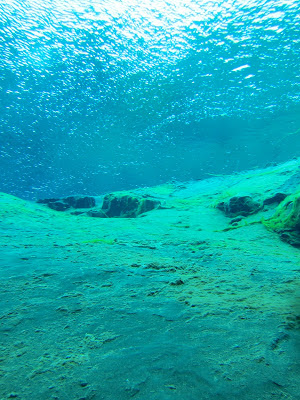 |
| in the lagoon |
 |
| in the lagoon |
The far side of the lagoon marks the exit point from the dive site, and from there it's a short (but breathless) hike back to the car park for a warm drink.
 |
in the lagoon |
For our second day's diving we headed to the Reykjanes Peninsula, south-west of Reykjavik, to dive in Kleifarvatn freshwater lake.
 |
| At Kleifarvatn |
 |
| pre-dive checks |
In 2000 two major earthquakes led to 20% of the lake's water disappearing, and it was noticed that the lake held submerged hot springs. The water level is now back to its previous level, for divers delight!

You don't need to dive very deep to see the bubbling springs - our maximum depth on this dive was only 8m.
 |
| Kleifarvatn's bubbling lake bed |
This was our warmest dive in Iceland - water temperature at the surface was 16°C, and 13°C a few metres below.
 |
| Kleifarvatn's bubbling lake bed |
 |
| If this is what the lake does to fish, what will it do to me?! |
But only after diving did our dive guide tell us the legend about a worm-like creature the size of a whale who lurks in the lake - the local equivalent of the Loch Ness Monster!

For my husband and I it reminded us of one of dives in Pulau Weh (Sumatra) when we dived on similar hot springs in another very volcanic part of the world.
 |
| fascinating to watch |
Still on the peninsula, our second dive of the day should have been in the sea near an aluminium smelting plant at Hafnarfjörður, however heavy swell and poor visibility meant we ended up aborting the dive.
 |
| dive site near Hafnarfjörður |
Our third and final day of diving was long but worth while. We set off at 6am for a 5 hour drive to the fjord of Eyjafjordur in Northern Iceland to dive geothermal chimneys at a site known as Strytan.
 |
| illustration showing Eyjafördur geothermal chimneys |
We set off from the tiny port of Hjalteyri, a small fishing village founded in the late 19th century.
 |
| jellyfish in the port, Hjalteyri |
The geothermal chimneys are remarkable in that they are the world's only undersea chimneys that can be explored using conventional (i.e. scuba) diving equipment. (Similar chimneys elsewhere in the world are at depths of 2000m or more). They are also home to an abundance of thermophilic organisms, some found nowhere else in the world.
 |
| the descent! |
The chimneys are continuously growing, the tallest of them currently towers around 60m above the seabed; its summit is about 15 metres below the surface. Although the chimneys are government-protected areas sightseeing diving is allowed, but you must proceed with great care.
 |
| the top of the tallest chimney appears |
The photo below isn't at an angle - the fish actually swim with their heads pointing downwards, presumably because of the chimney's freshwater current.

The chimneys are made of siliceous deposits. Hot, mineral-rich freshwater originating from the Icelandic highlands rises at a rate of up to 100 litres per second through the seabed, creating new crust (up to 300 tons per year) when the hot freshwater meets the cold sea.
 |
| close-up of the chimney |
The freshwater coming from the chimney has a pH of 10 and a temperature of 72-75°C and is apparently 1100 years old.
 |
| soft coral |
Water temperature during the dive was about 9-10°C at the surface and 7°C at 30m.

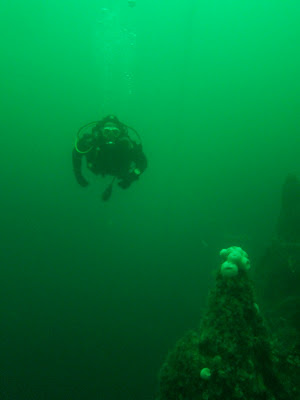
The site was discovered by diver Erlendur Bogason in 1997.
 |
| note the jellyfish in the foreground |
We then had a brief surface interval in our boat (during which we saw a whale) before diving on another geothermal cone site known as Arnarnesstrytur (or 'French Gardens').
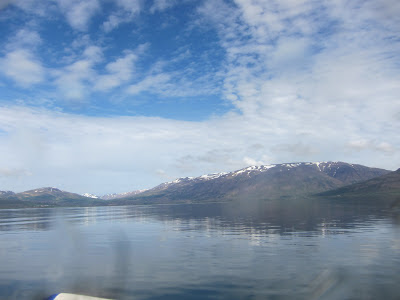 |
| Eyjafordur |
 |
| surface interval |
Arnarnesstrytur is a group of much smaller cones at depths from 18 to 46 metres.
 |
| cone at Arnarnesstrytur |
The cones themselves range is size from 0.5 to 12 metres high; we dived on the shallowest cone at 18m, from which hot water at 78°C streamed.

Strytan and Arnarnesstrytur are the only two protected underwater areas in Iceland. Strytan protected area is 200m in radius, and Arnarnesstrytur protected area (2007) is 400 x 1000m.

What was fascinating to me on this dive were the aggressive purple-blue wolffish - I'd never seen anything like them. They made me think of a human face stuck on a fish body - rather like drawings on those ancient maps labelled "here be sea monsters".
 |
| Atlantic wolffish |
In Iceland the species is called steinbítur, which translates literally as "stone biter". I don't know about stone, but one certainly tried biting our dive guide's buttocks!
 |
| Atlantic wolffish |
We also saw lumpsuckers guarding their eggs.
 |
| Face to face with a lumpsucker |
 |
| Lumpsucker seen from the side |
 |
| soft coral |
After our two dives it was time to make a quick trip to Akureyri (Iceland's second city - population 17000) for a late lunch before heading back to Reykjavik. Amazingly, because of the long summer days although we left Reykjavik at 6am and arrived back at 10pm it was light all day long.
 |
| jellyfish |
Our Icelandic dives were definitely amongst the most memorable we've ever done. Our incredible underwater experiences there more than made up for any cold we might have felt.
Related posts:
Suggested reading:
The Draining Lake: A Thriller (Reykjavik Thriller)![]() by Arnaldur Indriðason. A 2004 crime novel by the famous Icelandic author, featuring the fictional Detective Erlendur. The title is based on the real Kleifarvatn, and in the novel, the dropping water level revealed a body long hidden in the lake.
by Arnaldur Indriðason. A 2004 crime novel by the famous Icelandic author, featuring the fictional Detective Erlendur. The title is based on the real Kleifarvatn, and in the novel, the dropping water level revealed a body long hidden in the lake.
Useful links:
- Silfra.org
- Dive Iceland (the company we dived with)
- Dive.is
- Strytan Divecentre


