Showing posts with label Moheli. Show all posts

Monday, 22 January 2018

Moheli

We recently spent 11 nights at a hotel on the southern coast of Moheli, Moheli being the smallest (211 km2/81 sq mi) and least populated (38,000 inhabitants) of the three islands forming the Union of the Comoros. It only sees about 400 to 500 visitors every year.

view from the beach looking up towards the hotel bungalows

Hermit crab on the hotel beach

As the hotel is located opposite Moheli's Marine Park we mainly went for the diving (see separate blog post) but we also had time to relax, read, sleep and generally unwind. The Marine Park encompasses seven islets.

sunset over another two of the islets

looking towards the hotel beach from further afield

The hotel is on a beach enclosed on either side by a headland, which virtually makes it into a private beach, and there is a another small beach (barely visible on the photo above) which is accessible at very low tide. A short walk away is the long public beach of the town of Nioumachoua, Moheli's second town with a population of approximately 6,000.

a small part of Nioumachoua's public beach

We took some strolls through the town (which is really just a large village) and were intrigued to see a grand mariage was taking place, which is a traditional wedding ceremony performed in Comoros. It involves an exchange of expensive gifts between the couple's families as well as a festivities lasting up to 9 days for an entire village, and can cost as much as the equivalent of US$50,000. The most elaborate sometimes require more than 3 years of planning. Only by participating in the ceremony is a Comorian man entitled to participate in his village's assembly of notables and to wear the mharuma, a sash that entitles him to enter the mosque by a special door. 

part of grand mariage celebrations 
women dancing as they take the dowry to the bridegroom's home,
part of grand mariage celebrations

We could have gone to see turtles laying eggs on the beach at Itsamia, a 90-minute drive away, but as that's something we'd already experienced in Oman, we preferred going to see the island's endemic Livingstone' fruit bats. The International Union for Conservation of Nature considers the species as critically endangered, and as of 2003 (no more recent figure seems to exist) the total population in the wild was estimated at 1,200 individuals. Due to their imperiled status, the bats have been identified by the Alliance for Zero Extinction as a species in danger of imminent extinction.

a Livingstone's fruit bat

We had to hike for an hour and a half through forest, but our reward was getting to see these magnificent 'flying foxes' relatively close. The bats are only found on Moheli and neighbouring Anjouan, and only 15 roost-sites are currently occupied in Anjouan and six sites at Moheli.

Livingstone's fruit bat with wings spread

Although the bats are predominantly nocturnal there is some activity during the day, so we were able to hear and see the bats fairly easily.

flying Livingstone's fruit bat

teck tree near Livingstone's fruit bat roosting site 

skink in the forest

Longhorn beetle (Coleoptera cerambycidae)

a deserted beach near Ouallah on the island's west coast 

Moheli is about 10° further north than Reunion Island, and while most of the vegetation was familiar to us, some of the dishes served in the hotel were not. 

Mkatre Wa Foutra - a flatbread made using yeast, eggs and flour

Kuskuma - another type of bread

Madaba: moringa greens mixed with coconut & some fish. A Comorian staple.

fried breadfruit, served as a savoury accompaniment to a main course

fried banana, served as a savoury accompaniment to a main course

I also asked whether there was a Comorian equivalent to the ranon'apango (rice water: water boiled in the pan in which rice has cooked) that I enjoy so much in Madagascar. I was served this dish, which was more akin to a rice soup; I don't know whether that's the way it's served in the Comoros or just the hotel.

Comorian rice water ?

At the time of writing getting to Moheli entails a domestic flight via Grande Comore (flights between Moheli and Mayotte are not currently operating), and it is advisable to have leeway of at least 24 hours either side of your flight, as schedules can change at the last minute due to inclement weather or overbooking.


a member of the passion fruit family


Further reading:

Related blog posts:

Sunday, 21 January 2018

Moheli diving

Comoros is not a well-known tourist destination, and Moheli, the smallest of the Union's three islands, is even less so. Even in Reunion friends and acquaintances would look at me blank-faced when I mentioned where my next dive destination was. To be honest with a total of only 400-500 visitors per year the island is definitely off the beaten path. At the time of writing getting to Moheli entails a domestic flight via Grande Comore (flights between Moheli and Mayotte are not currently operating); Grande Comore can be reached with flights from Reunion, Mayotte and Madagascar and from Europe via Nairobi, Dar-es-Salaam or Addis Ababa.

Laka Lodge dive centre (on a windy day). As it's on the beach we patted down
our wetsuits every time to make sure no insect had taken refuge inside!

Unless you bring all your own equipment, any diving you do on Moheli will take place from the Dive Centre of Laka Lodge, a 3-star hotel located on the south coast of Moheli opposite the Marine Park of Moheli. The Park was created in 2001 and covers practically the entire southern coast of the island and encompasses 8 islets. 


sunset over some of the Marine Park islets

Diving is possible all year round and groups of up to 6 to 8 divers can be accommodated, although when we were there it was only ever just my husband and I or one other diver. All dives are without decompression for reasons of security as the nearest decompression chamber is in Mayotte. Depending on when you visit you may be accompanied by a divemaster as opposed to an instructor, so try dives and training may not be possible year-round. We were there in January, but I believe September is actually the best time of year to dive Moheli in terms of weather conditions. Humpback whales can be seen from July to October.

map of Moheli showing the main dive sites

Below are a few photos from the nine dives we did there on six different dive spots. We also saw - but don't have decent photos of - barracudas, a small nurse shark, octopi and various mantis shrimps.

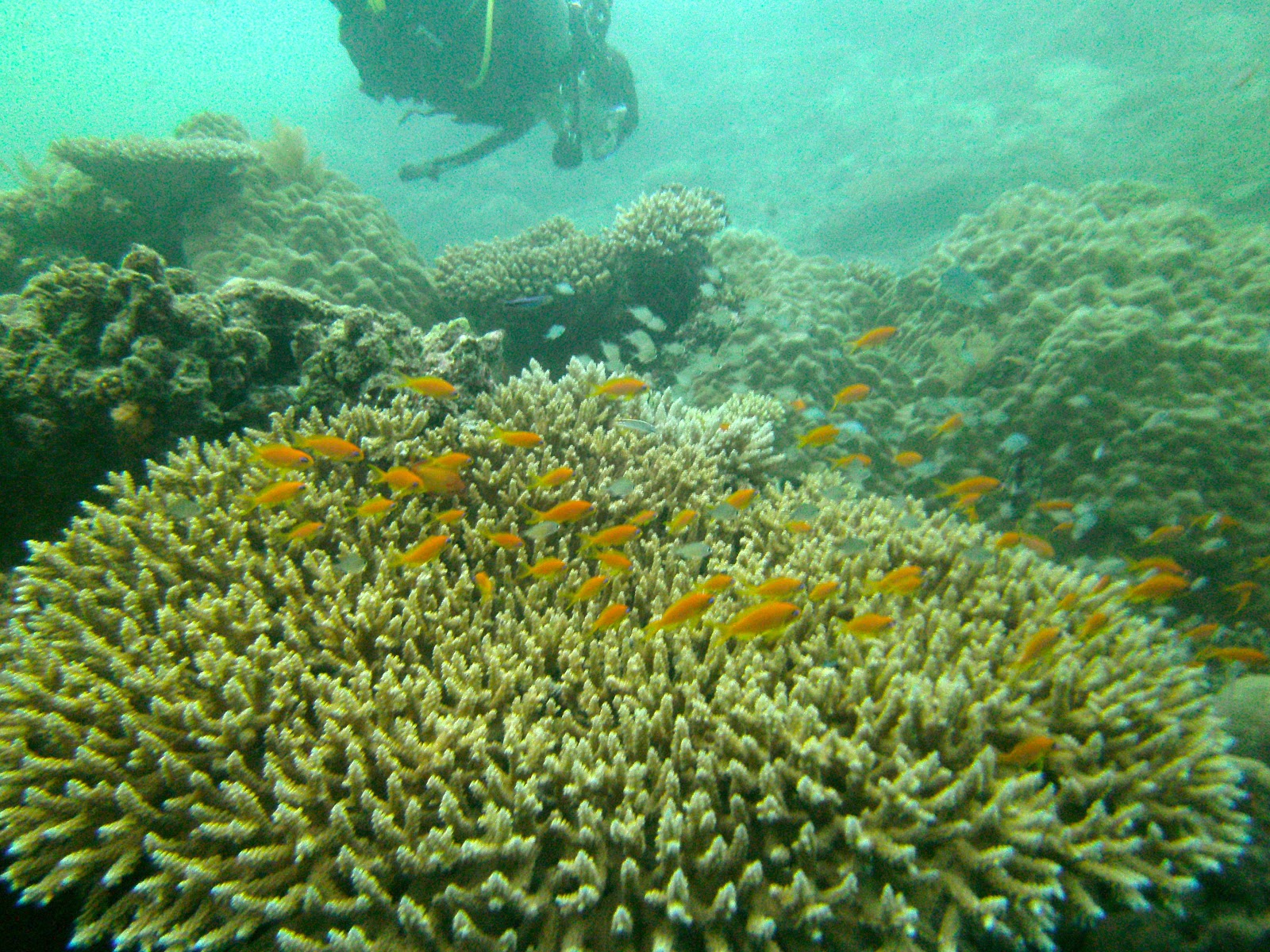
General view of the reefs, Glass Reef 

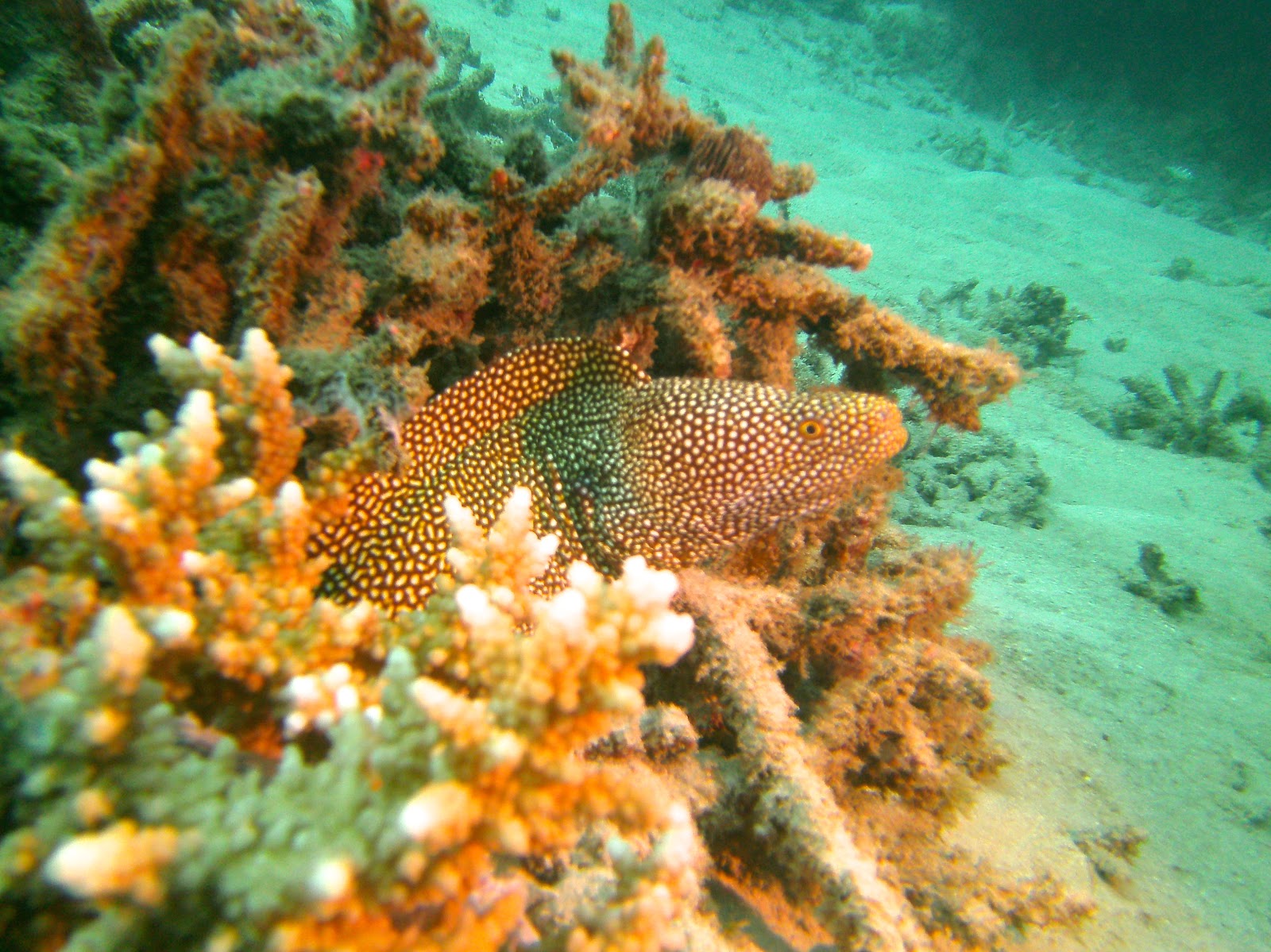
Moray eel, Glass reef

Leaf fish, Glass reef 

me looking at fan coral, Ras Kanzoni

me and a green turtle 

at Magic Rocks

at Mtsaka Point

Box fish, Mtsaka Point

at Mtsaka Point

rock shrimp, Magic Rocks

at Magic Rocks

cowrie shell with mantle, Masters 

scorpion fish at Mtsaka Point

Blue-spotted stingray, Masters

juvenile ribbon eel, Masters 

Guineafowl pufferfish, Glass Reef 

Lobster, Glass Reef 

Oriental sweetlips, Glass Reef

Coral, Glass Reef

two mangrove whiptail rays who had just finished mating

Puffer fish, Tombant des Phantomes 

Moray eel, Tombant des phantômes 

more lobsters, Tombant des Phantomes

The Comoros are of course well-known as being home to coelacanths but we had no such luck as of course we weren't diving that deep!


See also:


Further reading: