Showing posts with label Salazie. Show all posts

Sunday, 6 December 2020

Cascade Blanche

Falling 640 metres, Cascade Blanche is one of France's highest waterfalls, and Reunion's third-highest (the tallest is Trou de Fer). Often associated with Salazie as it lies near the entrance to the cirque, in fact it technically falls within the municipality of Bras Panon. It's very visible on the drive in and out of Salazie cirque, although on the way in you have to look back over your shoulder just past Pisse en l'Air to see it.

Cascade Blanche

Getting to a good viewpoint just opposite the waterfall is a fairly easy 35-minute hike, although actually getting to the foot of the waterfall is a little more "athletic" (it involves fording a river, wading through muddy channels, and clambering over large boulders).

sign near the start of the hike

Forestry Commission sign at start of hike,
warning that part of the pathway is unstable

a species of Heliconia growing wild

part of path

sign at the viewpoint marking the end of the maintained
path. While it doesn't forbid from going any further,
it warns hikers to watch out for flash floods in the river

view of Cascade Blanche from the viewpoint

After cooling our heels ankles in the river (called Bras de Caverne), we then made our way to the foot of the waterfall where we took a dip in the water before making our way back.


If you read/understand French you can find out more about the hike here:

view on the way back

See also:


Monday, 3 February 2020

A round-up of some blog articles about Reunion

While the articles on this blog are written directly by myself, I also work as professional French to English translator and I recently finished translating an interesting series of blog articles about Reunion written by Carole Hoareau. Aimed at tourists to the island, there's lots of useful information in these articles so I thought I'd collect them here for easy access. Most of the titles are self-explanatory and they're listed by order of publication on the blog, first to last. All photos are from the blog.


food in Reunion


Salazie


Bassin des Cormorans


Le Maïdo


frost in Reunion


road in the south of Reunion


an eruption of Piton de la Fournaise volcano 


Kelonia turtle sanctuary, Saint Leu


Mafate


Kaz Insolite, Reunion Island


Tuesday, 1 May 2018

Hellbourg to Belouve hike


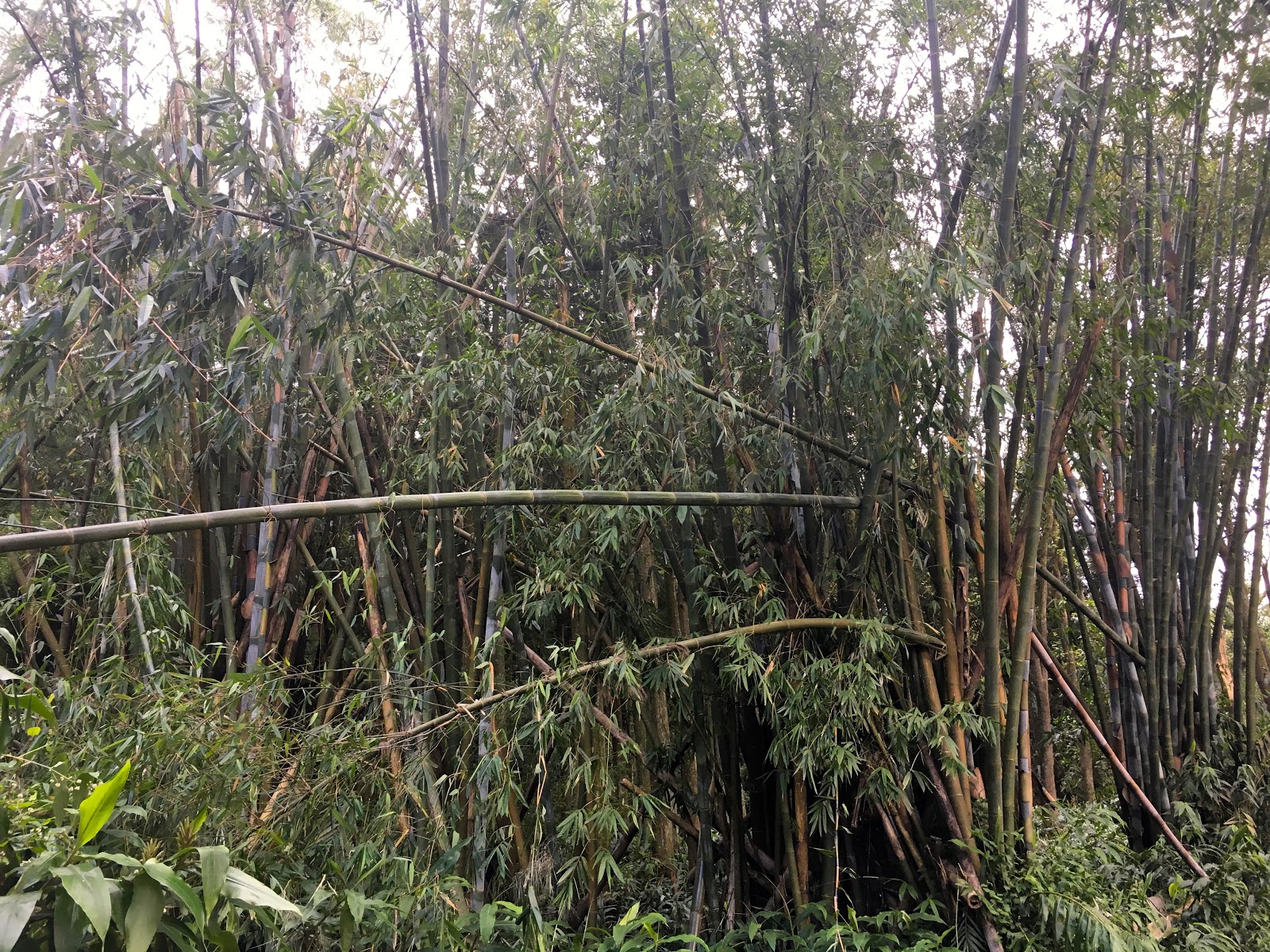
bamboo growing near the start of the hike

The hike from Hell-Bourg to Belouve is 3.5 km long, and climbs about 530 metres. The ONF sign (see below) says 1¾ hours are needed, but it only took us an hour and twenty minutes.

sign at the beginning of the hike, start of the path to right.


the hike up to Belouve is only one of several hikes
possible from the same starting point

Although Severe Tropical Storm Fakir had barrelled past Reunion only a few days previously, the path and surroundings were in a surprisingly good state. 

shrine beside the path

view from the path across the cirque of Salazie;
flat-topped Piton Enchaing to the left

fuchsia growing wild

Hydrangeas growing alongside the path

view across Salazie higher up the path, higher up;
this time Piton Enchaing is to the right

Towards the end of the path you suddenly come across two concrete pillars sticking out at a 45° angle. These are remnants of a now-defunct cableway that was inaugurated on 24th November 1954 and which linked Belouve and Hell-Bourg. It had a span of 1 202 metres, a gradient of 805 metres, and used a 1500-mètre long cable. 

concrete pillars near end of path

Then the path turns a corner and you come across more vestiges, together with another small shrine.

more relics of the cableway

path between the cableway and gîte

Once we arrived at the top we had a picnic lunch before heading back down the same way we came. Incidentally it's said the name of Belouve comes from the Malagasy word Belova which means "important or rich heritage" in English.

It took us 1 hour 20 to hike back down


You might also like:
view of nearby waterfalls when driving home

Sunday, 6 March 2016

Maison Morange music museum


Inaugurated in Hell-bourg, Salazie, in November 2015, Maison Morange is a museum about Indian Ocean music and musical instruments. Located in a traditional Creole house (built in the 1920s by the former mayor of Bras Panon, Henri Morange), it displays over 400 instruments (from a selection of almost 2,000 collected over forty years by François Menard and Robert Fonlupt), it is France's third richest music collection. The museum itself took four years to see the light of day, and covers 450m2.


Reunion is of course remarkable by the diversity of its people, and this is reflected in the music and instruments displayed, which - like the Reunionese people - come from Africa, Madagascar, India (both Tamil and Gujarati) and China.


A small audioguide allows you to listen to the sound made by various instruments without disturbing other visitors, and all written texts have been translated into English, German and Spanish.

Indian processional handcart, on display in the entrance

The local music genres that have been born of the mix of this diversity, principally maloya and sega, has not been forgotten either. For information, in 2009 maloya was inscribed on the UNESCO Representative List of the Intangible Cultural Heritage of Humanity.


Some maloya musical instruments on display: three drums, a piker at
the back, a kayamb at the front, and a bobre musical bow at the far left.

a selection of sega and brass band instruments

Each region has a room or rooms devoted to it. For China drums, gongs and cymbals are on display, amongst other instruments, and there is also a section on Tibetan music (religious and profane).

Part of the Chinese display

bronze Bianzhong? bells, Chinese display

In ancient China music was believed to be of divine origin, and it was thus granted great importance. It was a discipline that every gentleman, educated according to the Confucian tradition, would practice.

recreation of the boudoir of a Chinese man of letters

In the corridor the four divisions of musical instruments are shown: membranophones, chordophones, idiophones and aerophones. Even if instruments were made in different geographical regions by people of different cultures they are all based on the common principles of sound production, and can thus be classed into one of the above groups. 

This Chinese gong belongs to the idiophone group

Drums are part of the membranophone family
The festive aspect of African music in Reunion often overshadows its ritualistic origins.

part of the African display

Hindu Indian indentured workers arrived in Reunion to work on plantations after the abolition of slavery in 1848. Like the Chinese, Indians also attribute a mythical and divine origin to their music, and many deities of the Hindu pantheon are represented playing instruments. From the 16th century onwards Mughal princes in Hindustan developed a refined courtly lifestyle, and until the early 20th century princes and Maharajahs maintained groups of musicians and had music rooms where the latter performed.

Private music room of a Maharajah

Due to its size India has a wide diversity of cultures, and the musical instruments created by its people reflect various social and religious traditions. Animals and family life feature strongly amongst these themes.

Tribal Indian instruments

In the museum a small Indian luthier's workshop has been recreated. He and his assistants would have worked sitting on the floor, surrounded by tools and half-made instruments.

part of the workshop of an Indian luthier

Madagascar is itself an island that has been influenced by East Africa, the Arab world, Indonesia and Europe, but its music is nevertheless original. Malagasy have local versions of lutes, zithers, and brass bands, but it is the valiha - a bamboo tube zither - which has become the 'king' of Madagascar's instruments. Maybe that explains why I found the display of valihas one of the most beautiful exhibits in the whole museum.

display of valihas

Practical info:
  • Open Tuesday to Sunday 10am to 6pm (closed Mondays).
  • Price €7, free for children aged 8 and under.
  • Website: http://www.maisonmorange.fr (French only)

© Maison Morange

© Maison Morange

© Maison Morange

© Maison Morange


You might also like :