After arriving in Australia via Perth and spending 24 hours in WA with friends we then flew to Melbourne, the capital of Victoria and Australia's second largest city. We spent our first day there visiting the city centre. As July is winter is was suprisingly cold, and we had to be quite wrapped up, especially once the sun set.
looking north across the Yarra River
looking north across the Yarra River
looking north across the Yarra River
Hosier Street, Melbourne
The next day we cycled to Brighton Beach, where we saw some very colourful bathing boxes.
beach hut at Brighton Beach
beach huts at Brighton Beach
Melbourne city skyline from Brighton Beach
On our third and final day we visited Healesville Sanctuary to see some native Australian fauna.
wallaby
dingo
kangaroo
echnida
Koala
On leaving Melbourne we travelled to Tasmania, then flew to Sydney. Our first stops there were of course Sydney Opera House, and Sydney Harbour Bridge.
Sydney Opera House
Inaugurated in 1973, the Sydney Opera House is a great architectural work of the 20th century that has had an enduring influence on architecture. It has been inscribed on the UNESCO World Heritage List as a cultural property since 2007.
Sydney Opera House by night
Sydney Harbour Bridge
view of Sydney harbour from the bridge footpath
Sydney Opera House and Bridge together at sunset
Mrs Macquarie's Chair is an exposed sandstone rock cut into the shape of a bench, on a peninsula in Sydney Harbour. It was hand carved by convicts in 1810, for Elizabeth Macquarie, the wife of Major-General Lachlan Macquarie, who was Governor of New South Wales 1810 to 1821. Folklore has it that she used to sit on the rock and watch for ships from Britain sailing into the harbour. The peninsula itself is named Mrs Macquarie's Point, and is part of The Domain, near the Royal Botanic Gardens.
Mrs Macquarie's Chair
ANZAC bridge
We also visited the Art Gallery of New South Wales.
Captain Cook, reflecting on his legacy?
Tumbalong Park, Sydney
On our final day we headed to the North Shore and visited Bondi Beach, amongst other places.
Sydney from Bradley's Head with a wedding in the foreground
Sydney from Bradley's Head
Bondi Beach
Bondi Icebergs Club swimming pool
Northern end of Bondi Beach at day's end
On our way back to Reunion via Perth and Mauritius we spent a night in Sydney and stayed near Manly Beach.
On our trip to Australia we managed to fit in three days' full diving. We started at the Great Barrier Reef, a UNESCO Natural World Heritage site, and first tried to dive at Fitzroy Island, near Cairns, but the visibility was pretty bad, so we gave up. We headed out the next day with Tusa Dive to Hastings Reef on the Great Barrier Reef, where we did two dives at a site called Fish Bowl, before heading to another site called Coral Gardens at Saxon Reef for our third and final dive of the day.
diving at Hastings Reef, Great Barrier Reef
The diving was good but visibility was so-so, and as we're used to diving in tropical waters a lot of what we saw was similar to our Indian Ocean diving. As August is (southern hemisphere) winter, temperatures were similar to Reunion at the same time of year (23-24°C), even though Cairns is further north (16°N).
diving the Great Barrier Reef
We didn't take our own wetsuits, and the 5 mm ones they supplied us with were long-sleeved but short-legged - something I'd never seen before!
with a clam, Hastings Reef
Hastings Reef
Hastings Reef
me with a turtle, Saxon Reef
spot the ray! Saxon Reef
Two days later we were about 450km further south near Ayr, to dive the Yongala with Yongala Dive. The SS Yongala was a vessel built in 1903 that sank during a cyclone on 23rd March 1911 en route from Melbourne to Cairns with the loss of all 122 passengers and crew aboard . It created one of Australia's most intriguing maritime mysteries, as she lay undiscovered for more than half a century, until 1958.
diagram of the SS Yongala
Today the coral-encrusted wreck has become home to an incredible array of marine life: giant gropers, giant trevally, cobia, sea snakes, turtles, batfish and moray eels. Everything we saw there seemed larger than the same marine life seen elsewhere.
We did two dives, and frustratingly another group of divers who came up from their second dive a few minutes after us had just seen a bull shark.
looking back from the bow§, SS Yongala
The wreck is 109 metres long. The bow points in a northerly direction (347°), and although she lies listing to starboard (right), the vessel's structural integrity has been retained.
SS Yongala
The depth of water to the sea floor is approximately 30 metres, with the upper sections of the wreck 16 metres below the surface.
SS Yongala
Although the Yongala lies within the central section of the Great Barrier Reef, the sea floor surrounding the wreck is open and sandy, so it has become an established artificial reef, providing a habitat for a wide range of marine life.
moray eel, SS Yongala
As there was loss of life on board the vessel when it sank it is now a protected dive site and you are not allowed to penetrate inside.
spot the turtle, SS Yongala
Our final Australian dives were probably the best! We dived with Wolf Rock Dive off Rainbow Beach in southern Queensland, a full thousand or so kilometres south of Ayr (latitude 25°S). What makes Wolf Rock special is that grey nurse sharks (also known as sand tiger shark, spotted ragged-tooth shark, or blue-nurse sand tiger) are found there all year round.
map of Wolf Rock
The numbers of sharks vary according to their lifecycle and the largest amount are always seen from spring through to autumn (the dive club has counted up to 54 in one go).
grey nurse sharks at Wolf Rock
We did two dives and on the first dive saw a handful of sharks, plus several manta rays, an eagle ray, a Queensland grouper (also known as giant grouper) and schools of batfish and barracuda. On the second dive we hit the jackpot and saw 16 sharks! We also saw an enormous green turtle and a manta ray during our safety stop.
grey nurse sharks at Wolf Rock
shark's tooth in the hand of the our dive guide
Despite many of the sharks being pregnant females they didn't seem to be perturbed by our presence, however they did react a little agitatedly to a free diver during our first dive.
manta ray, Wolf Rock
Wolf Rock is actually a set of four volcanic pinnacles two kilometres north-northeast of Double Island Point in Cooloola, Queensland. It is said the rock was named for one of Captain Cook's crew who first saw the rocks on rounding Double Island Point. There was certainly an Archibald Wolfe on Cook's voyage, but Cook doesn't record the rocks, nor anyone in particular seeing them (or the point) first.
manta ray, Wolf Rock
Wolf Rock is considered by the Queensland Government to be Queensland's most important habitat area for the critically endangered grey nurse shark.
we saw many (unidentified) jelly fish during our 2nd safety stop at Wolf Rock
On leaving Melbourne we flew to Hobart in Tasmania (incidentally the domestic flight between the two cities had the quickest formalities I've ever experienced. We arrived at Melbourne rather late and the ticket machine gave us front row seats. Security was fast because they don't check water bottles. And because we had front row seats we were first to board. Time from arrival at the airport to being sat in our seats in the plane: 22 minutes!). Although we landed in Hobart we just spent the first night there, then hired a car and set off south-east to the Tasman Peninsula to see Pirates Bay and Tasman Arch.
lookout over Pirates Bay, Tasman Peninsula
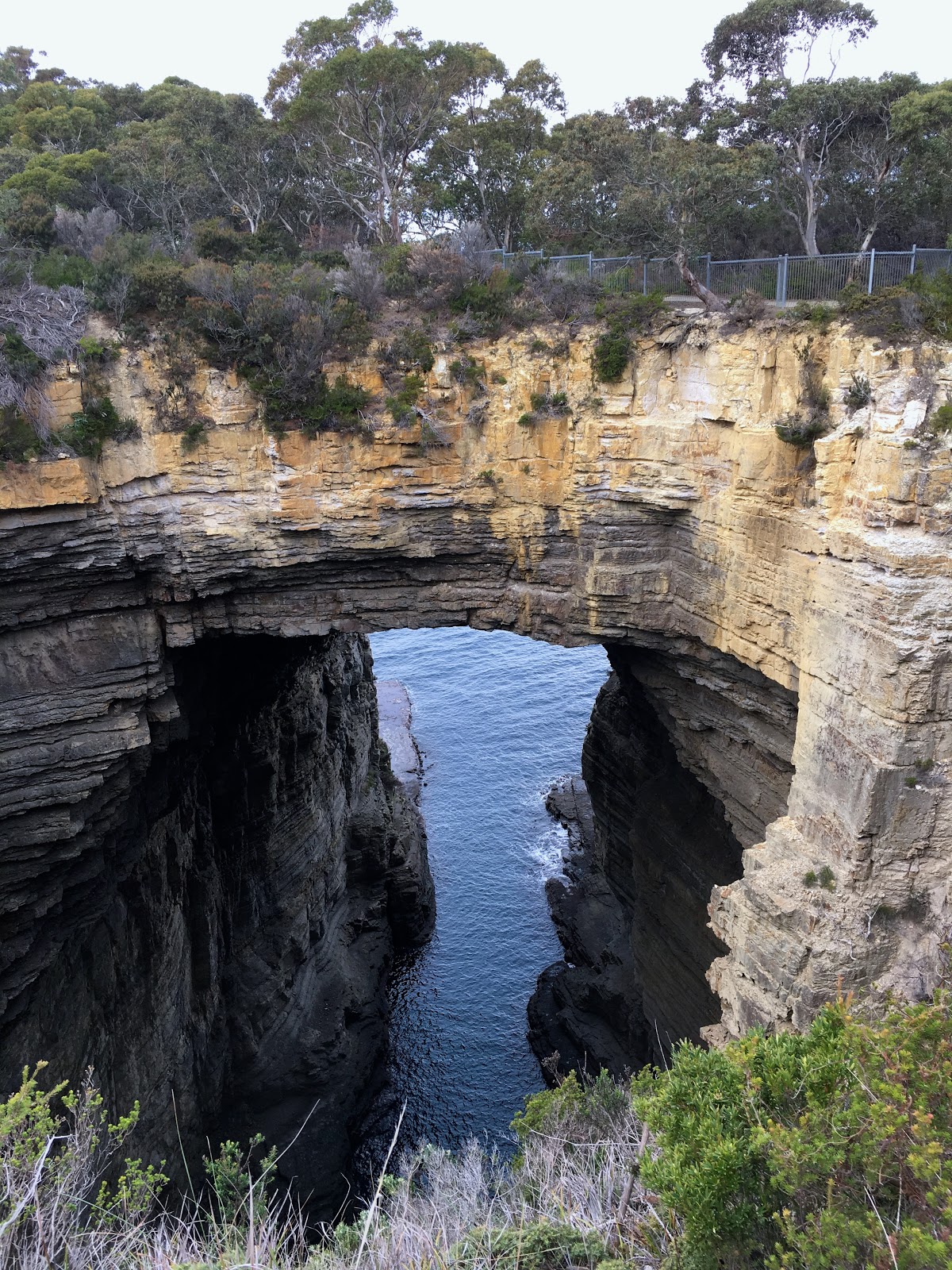
Tasmans Arch was created by wave action over many thousands of years and is all that's left of the roof of a large former sea cave or tunnel.
Tasman Arch
We then headed up the east coast, and our first overnight stop was in beautiful Freycinet National Park, where we spent our 10th wedding anniversary at Freycinet Lodge.
view of idyllic Freycinet Lodge from across the water
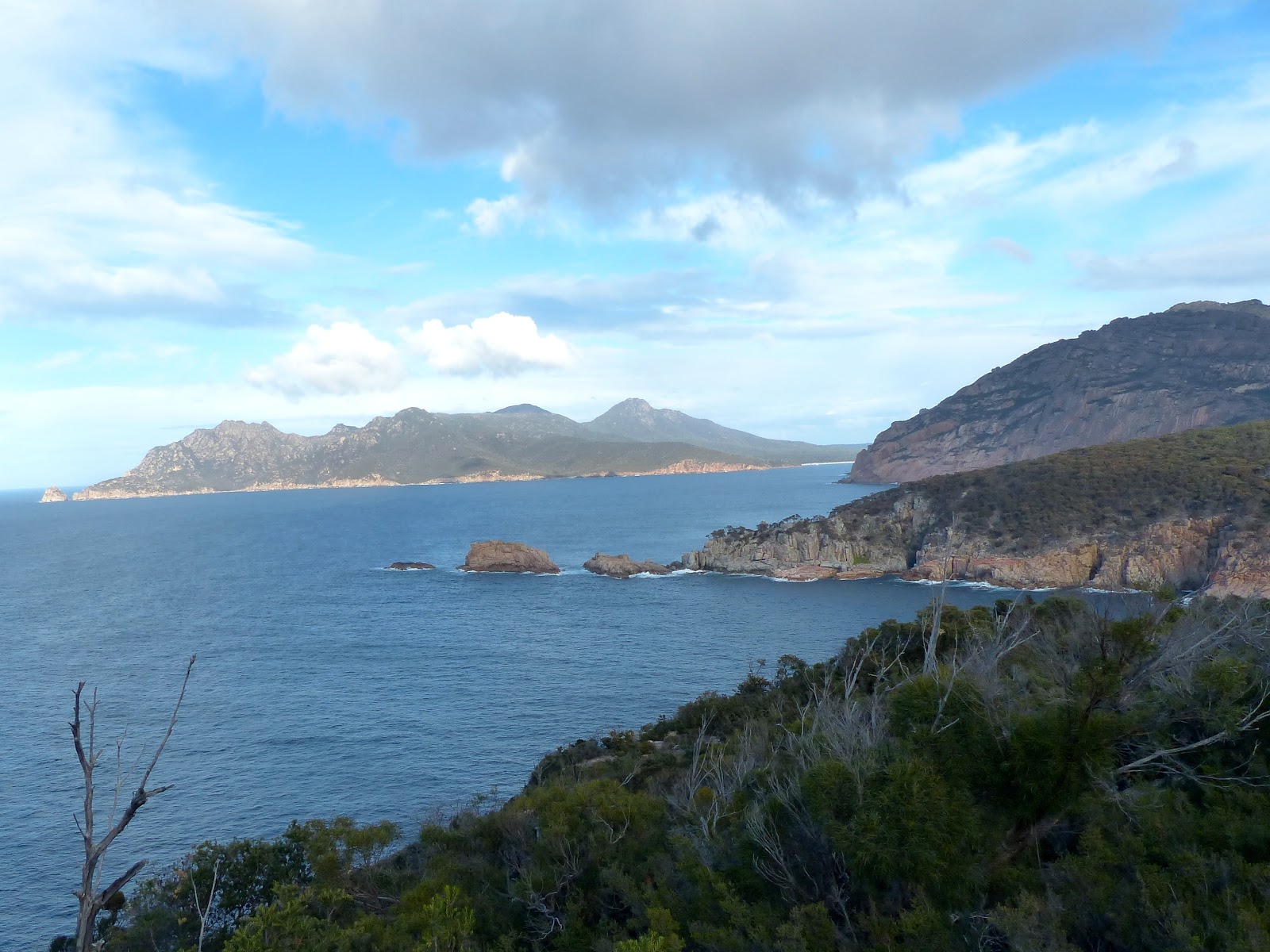
view from Cape Tourville Lighthouse, Freycinet National Park
walking in Freycinet National Park
Wineglass Bay, Freycinet National Park
We then headed up to Launceston, in the north, Tasmania's second largest city with a population of 100,000. Here we visited Cataract Gorge, which is very close to the city centre.
at Cataract Gorge
Cataract Gorge
at Cataract Gorge
wild wallaby? at Cataract Gorge
The next day we drove back down to Hobart, taking the scenic route through the centre of the island. We passed through the historic town of Oatlands and also saw a wild eagle.
Callington Mill, Oatlands, Tasmania
eagle, Tasmania
On arrival back in Hobart we headed up to Mount Wellington, which is at 1271 metres above sea level, and where we had patches of snow and a temperature of -2°C in the early afternoon!
it was cold on the top of Mount Wellington!
Hobart from Mount Wellington
In Hobart's port the icebreaker Aurora Australiswas berthed. It was first launched in 1989, and is owned by P&O, but is regularly chartered by the Australian Antarctic Division (AAD) for research cruises in Antarctic waters and to support Australian bases in Antarctica.
the Aurora Australis in Hobart port
In the evening we headed to the area of Salamanca Place, a picturesque row of four-storey sandstone warehouses. Behind is Salamanca Square, an area which has been redeveloped with shops, restaurants and businesses.