Saturday, 23 August 2014

Cross stitch

I'm now unable to cross stitch following two operations to my left hand which have left it without strength or fine motor skills (I'm right handed, but would still need my left hand to hold what I'm stitching). However during the dozen or so years I stitched (from about the mid 1990s to the mid 2000s) I did quite a number of projects. Here are some photos.

Samplers

this red & white monochrome was one of the first samplers I ever stitched

this Museum of Childhood sampler was a gift to my parents

I stitched this in 1996 for my parents' Ruby Wedding anniversary

this more elaborate sampler was also a gift to my parents,
for their Golden Wedding Anniversary in 2006

close-up of the Golden Wedding Anniversary sampler 

this was also a gift for family members when one of my nieces was born

another sampler for another niece, born the same year

I liked this modern take on a traditional sampler, which includes eyelets

Ceud Mile Failte means 'A hundred thousand welcome's in Gaelic

not a sampler but this stylised knot also has a Celtic theme

Places

Stellenbosch is in South Africa, near Cape Town

Stellenbosch (the name literally means "town of oaks") was founded in 1679. The sampler shows Bletterman house flanked by oak trees as well as the surrounding mountains and the nearby Eerste River. The grapes and baskets of flowers depict the fruitfulness and viticulture of the area, and the border shows acorns. The harp symbolises the music and arts and the owl represents wisdom and knowledge (the town has a University). 

Robert Burns was born in this thatched cottage in Alloway, Ayr, Scotland
in 1759. It now houses a commemorative museum.

Dunvegan Castle is also in Scotland 

the only English place I've cross-stitched: Moot Hall in Keswick

a stylised "Fife House"

Rhode Island was the first in a series of American places for my brother 

Cincinnati, in the same series

this homey American style was a gift from a friend, so not stitched by me

in a similar style this welcome window hanging expresses
the same sentiment as 'Ceud Mile Failte', above

"Life is a journey", a small project but with an interesting frame


Fruit & flowers

this basket of apples was one of my first ever sizeable projects!


lavender montage 

the Chinese character for "love"

this hare was a Lunar New Year gift for a friend 

these roses were stitched in the distinctive
style of Charles Rennie Mackintosh

Art Nouveau summer roses

fuchsias are one of my favourite flowers
(as you can see here and below)

more fuchsias

the fuchsia flower fairy 

Fuchsia is a dancer
Dancing on her toes,
Clad in red and purple,
By a cottage wall;
Sometimes in a greenhouse,
In frilly white and rose,
Dressed in her best for the fairies’ evening ball!

'Roessa anja' fuchsia

fuchsias against a night-time background

Dutch tulip bulb 

stylised tulips 

small hanging

Moonflower 

this Agapanthus and antique fence is one of my favourite projects

 a poppy-themed photo frame

toadstools 

Miscellaneous

gift from a friend

my motto


stained glass window 

butterfly

seashells 

lighthouses

sailing boats continue the nautical theme

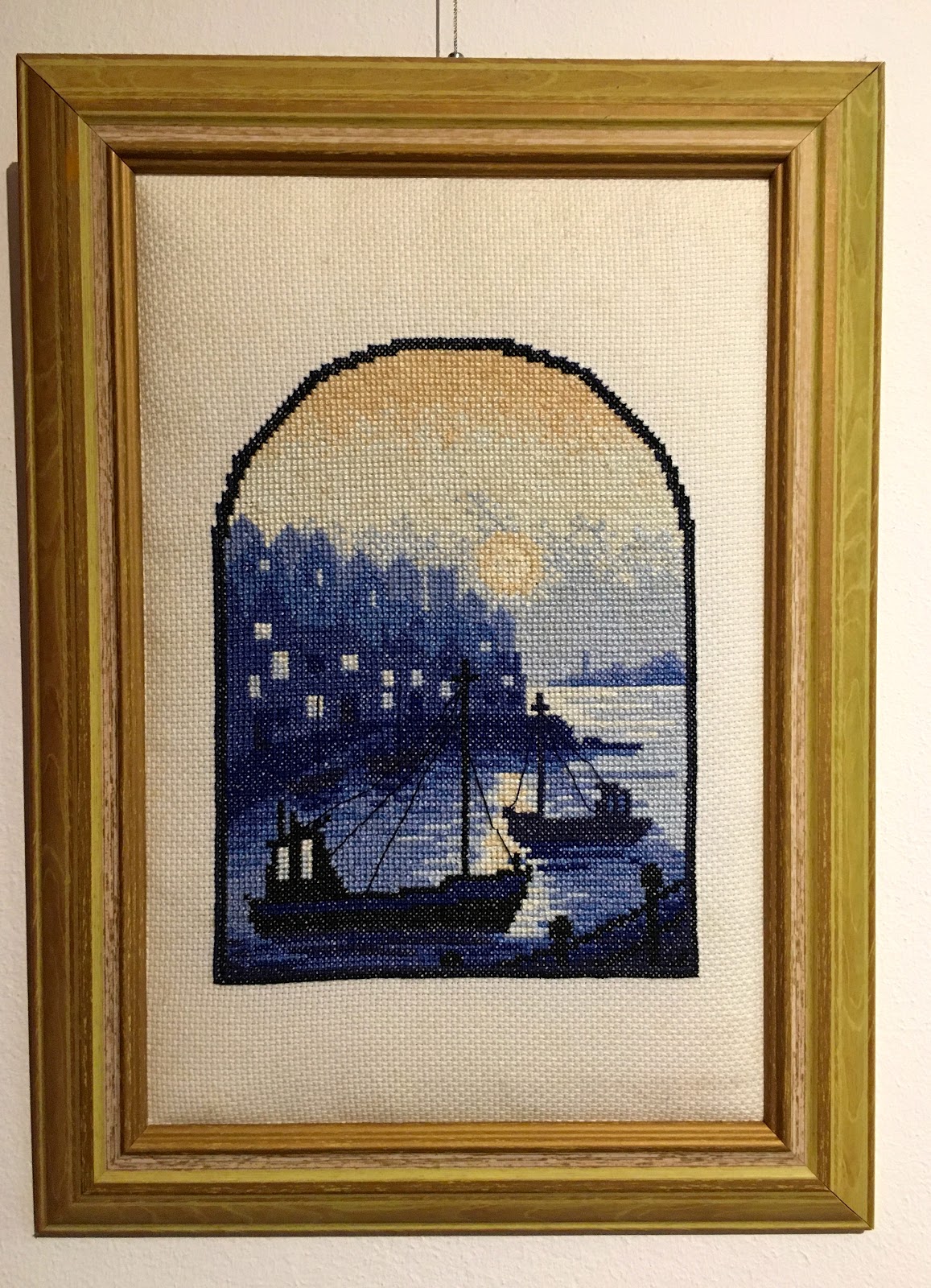
night time scene, with silvery thread for the moon

All Our Yesterdays: As far as we go

a dreamcatcher

purple bookmark
another bookmark

beaded front of a notepad

Queen's Golden Jubilee sampler

one of my more practical projects: a clock 

Finally, here are some cards that I stitched over the years for various occasions: birthdays, Christmas, Mother's Day, housewarming, Easter etc.


I also stitched some coasters, but after several years of use they're not longer very photogenic!


Sunday, 22 June 2014

June 2014 volcano eruption

After almost four years of silence Reunion's Piton de la Fournaise volcano, one of the most active volcanoes in the world, started erupting yesterday (June 21st) at 1:35am this morning. The eruption started on the southeastern side of the main summit crater, in a very remote part of the volcano, so there was little-to-no threat from the flows, unlike the eruption in 2007. There had been 10 days of precursory signs that an eruption was in the works, with higher gas emissions and seismicity, along with a red glow in the area very recently. After about 20 hours the eruption came to a stop.

Here are some pictures.

© AFP Photo / Richard Bouhet

This was the 11th eruption in 10 years.

© AFP Photo / Richard Bouhet

The previous eruption was October 14th-December 10th 2010.

© AFP Photo / Richard Bouhet

See also this video, shot by local TV channel Antenne Reunion:


Useful links:
  • Volcano observatory webcams (although unfortunately this current eruption is not occurring in view of any of the webcams pointed at the volcano).

You might also like: 


Saturday, 3 May 2014

Jardin d'Eden

Reunion's 'Garden of Eden' is a tropical, ethnobotanical garden spread over two and a half hectares on the island's west coast at St Gilles.

Entrance to the Jardin d'Eden

The Garden is divided into a number of theme areas: ethnobotany, fragrant plants, a zen garden, an aquatic area, and also has some bee hives. It is a member of  Botanic Gardens Conservation International, the Association of Botanical Gardens of France, and the French National Council for the Conservation of Plants and Gardens.

The Jardin d'Eden reception area in an enormous oak vat, built in
1847 and which contained 510,000 litres of rum!

600 different plants grow in the garden. Most are labelled with their latin and local names, plant family and place of origin. The labels use a colour-coded system: yellow for medicinal plants, red for fragrant plants, white for those used for edible or dyeing purposes and green for plants that are simply attractive to look at! There are also endemic, sacred and spice plants as well as palm trees, cacti and bamboo.

Strelitzia

The plant families with the most varieties are: Euphorbiaceae and Liliaceae (40+ each); Leguminosae, Apocynaceae and Palmae (30+ each); Acanthaceae, Araceae, Gramineae and Cactaceae (20+ each).


About 60 noteworthy plants are explained in greater detail in a booklet (in French, English or German) that is lent to you at the start of the visit.

Gomphocarpus physocarpus / Ballonplant / Ti-ouete

Cannabis in Reunion island is called 'zamal', from the Malagasy word zamala. It doesn't grow wild on the island, only where it has been planted (generally in the middle of a field of maize or sugar cane)! In the Garden it's been planted in a 19th-century copper cauldron used by Mme Desbassyns to feed the slaves on her plantation in order to symbolise the slavery that the use of cannabis entails.

Cannabis sativa / Cannabis / Zamal 

Hibiscus calyphyllus / Lemon Yellow Rosemallow 

Vetiveria zizaniodes / Vetiver / Vetyver

bamboo root

Crescentia cujete / Calabash / Calebassier, native to Panama

Pomegranates were brought back from the East via Northern Africa by the Romans at the time of the Punic Wars, hence its Latin name Punica. (Modern-day Tunisia roughly corresponds to what was Punic territory). The fruit peel, stalks and roots of pomegranates can be used for their yellow colouring properties and are used to dye Tunisian carpets and tan Moroccan leathers. According to Chinese medicine the pomegranate is also an efficient vermifuge, in particular for tapeworm.

Punica granatum nana / Dwarf Pomegranate / Grenadier nain, native to Iran

Ficus aspera / Clown Fig / Figuier clown, native to the S. Pacific

A number of animal species visit or live in the Garden such as moorhens, bitters, turtledoves, waxbills, and bulbuls.

dragonfly

In the aquatic zone is papyrus, used by the Egyptians to make parchment. Papyrus have a ball-like head made of thread-like leaves.

Cyperus papyrus / Papyrus

in the aquatic area

in the aquatic area


For most of the year the Lipstick tree (or 'Achiote') looks like an ordinary shrub (see below). But between May and August it bears scarlet fruit that have long been used by the American Indians to dye their hair and skin; a paste can also be made to colour lips. These 'redskins' fought Francisco de Orellana when he explored South America in 1541-42 and the scientific name refers to him. One tree gives 150-250kg per year of  seeds and pulp containing  carotenoids and tannin. Today, as well as being found in lipstick, the red dye from this shrub is also used in the paraffin coating of certain Dutch cheeses.

Bixa orellana / Lipstick tree / Roucou, native to tropical America

The Golden dewdrop is the garden's mascot plant. Its fruit are odourless but toxic and can only be eaten by birds. It has purple flowers which smell like vanilla, hence it's local name of "wild vanilla".

Duranta repens / Golden dewdrop  / Vanillier marron

In a climate like that of Reunion, the long furry red catkins of the Chenille plant flower all year round. The catkins are made of thousands of tiny flowers and are only found on female plants.

Acalypha hispida / Chenille plant / Queue de mimite, native to India

The 'Traveller's palm' is the emblem of Madagascar however it is not a true palm but a member of the bird-of-paradise family, Strelitziaceae. Ravenala, as it is known locally, means 'leaf of the forest' in Malagasy. The sheaths of its stems hold rainwater, which supposedly could be used as an emergency drinking supply for needy travellers. However, the water inside the plant is murky, black and smelly and should not be consumed without purification. Another plausible reason for its name is that the fan tends to grow on an east-west line, providing a crude compass reference. Its leaves can be used to roof huts or for medical treatments such as generalised oedema.

Ravenala madagascariensis / Traveller's tree / Arbre du voyageur

The Garden is open daily from 10am to 6pm, closed only for Christmas and New Year's Days.


See also the Garden's own website (in French only) for the address and contact details.


If you enjoyed this post you might also like: