Showing posts with label St Paul. Show all posts

Wednesday, 16 September 2020

Chemin Pavé Lougnon, Bellemene

Chemin Pavé Bellemène is one of three paved pathways that Antoine Desforges-Boucher*, then Governor of Reunion Island, had built between 1723 and December 1725. He encouraged settlers to plant coffee, and the paths were to help transport the crop downhill to the large warehouse in Saint-Paul (which is now the Town Hall). The first path was laid in 1719, and the Bellemène path was the last of the three to be built. Today it is the only one remaining, as increasing use of asphalt roads from 1910 onwards led to all three paths falling into disuse and being forgotten. Albert Lougnon 'rediscovered' it in the late 20th century (hence its alternative name, Chemin Lougnon), and this led to its renovation by local associations between 1999 and 2006. In certain places it was covered by two metres of earth!

start of the paved path, Tour des Roches

On some sections of the path you can clearly see a line of differently-sized and -placed stones running along the middle. This may have been to make it easier for pedestrians (as opposed to ox-drawn carts) to walk, or it may have been to delimit two different directions of traffic (a bit like today's two-lane roads).

note the stones running along the middle


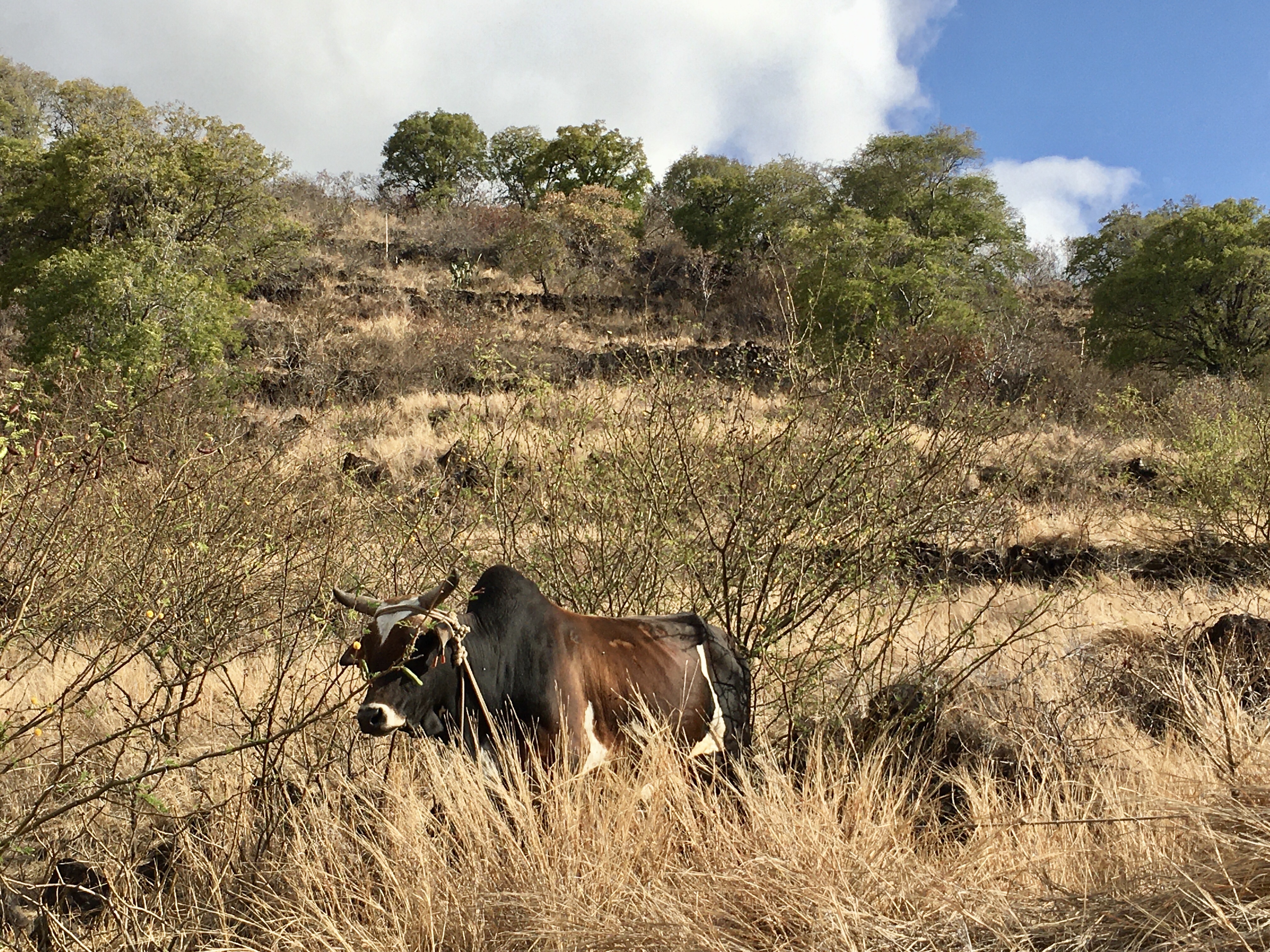
being watched by a zebu

Leconte de Lisle, a French poet who grew up on Reunion Island, wrote a poem in which he mentions his muse and cousin, Marie-Elixène de Lanux, coming down the path:
"Sous un nuage frais de claire mousseline, tous les dimanches au matin, tu venais à la ville en manchy de rotin, par les rampes de la colline." (Le Manchy, Poèmes Barbares)

"Under a cool cloud of clear muslin, every Sunday morning you came down the winding hill into town, carried in a rattan litter."


the branches of these two trees have become intertwined

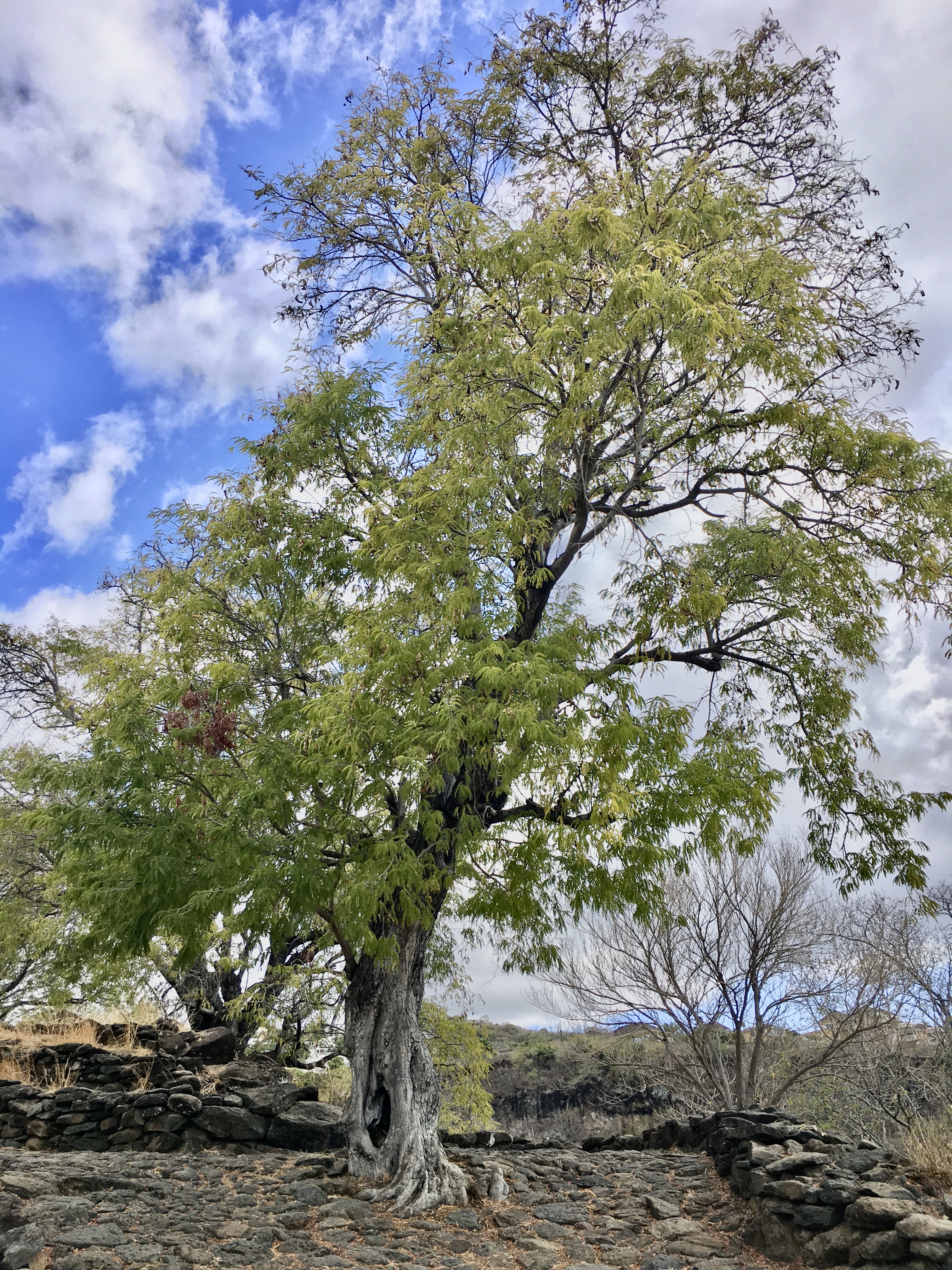
a Pithecellobium dulce tree, also known as
monkeypod due to its coiled pods
which are said to resemble monkey's earrings!

view looking north-west, unidentified tree in the foreground


Saint-Expedit by the side of the path

cactus

view looking south-west, agave stem in the foreground


photo from the Bellemène end of the path, looking back

From a practical point of view, you can either start the walk at Tour Des Roches and go uphill (and then back down), or start in Bellemène and walk down and then up. The path is quite steep (just under 200m of elevation gain) but the round-trip distance is 2.5 to 3 km, so it should only take you about an hour. The following links describe the walk and give more technical details but are only in French:

on a house near the start of the path in Tour des Roches a 
sign says: "Hey, papaya thieves, next time you will die!"

* not to be confused with his son, Antoine Marie Desforges-Boucher, who was also a Governor of Reunion 1759-1766.


See also:


Sunday, 26 March 2017

Diving the Hai Siang

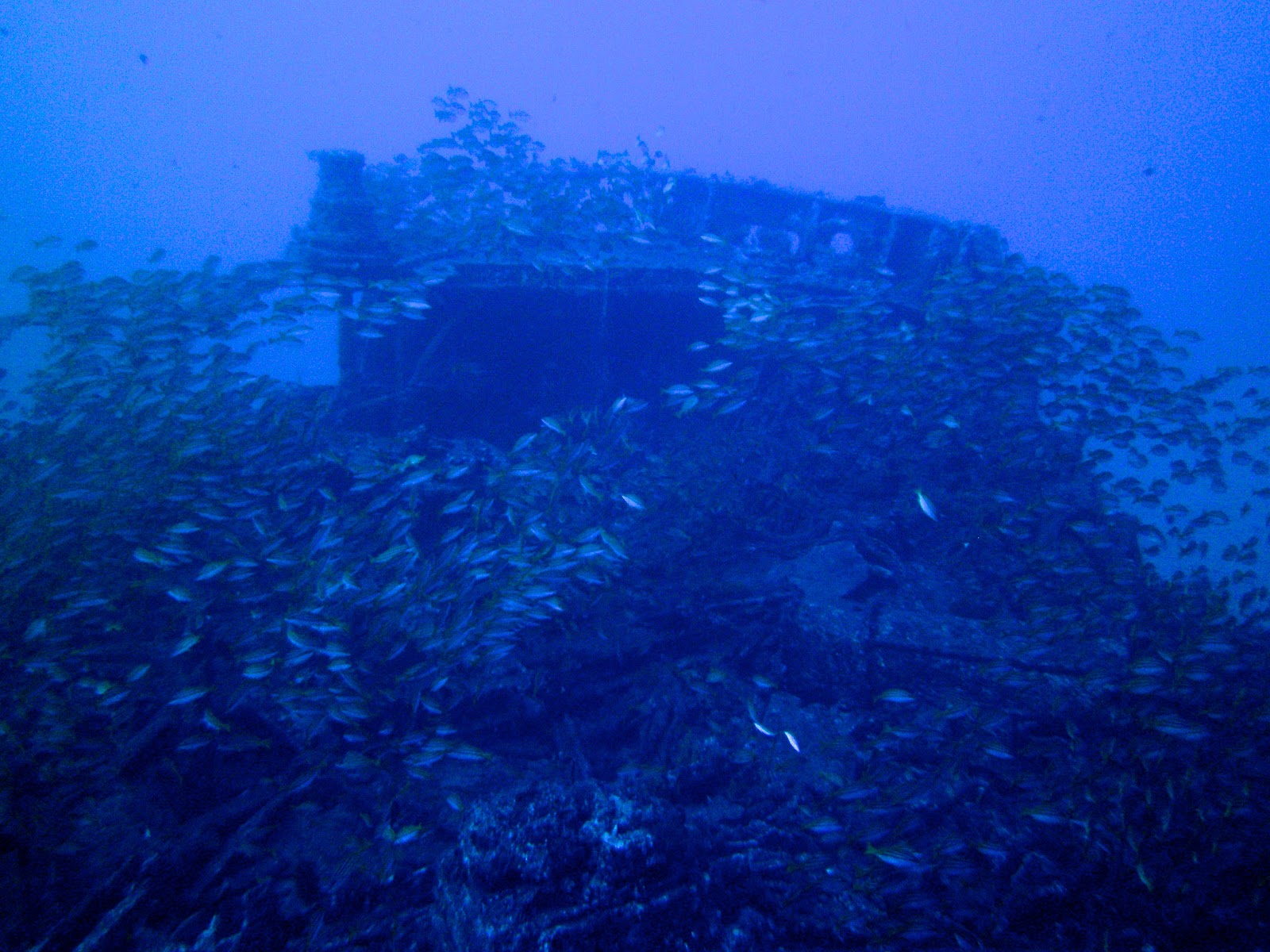
The Hai Siang is a 49-metre former Taiwanese fishing boat that was voluntarily sunk off the coast of Cap Homard (Reunion Island) in 1983. The name means 'wild pig' in Chinese. It lies on a sandy bottom at 55 metres deep and, if you are appropriately qualified, it makes for good diving as you can see from the photos below. We saw lots of snappers, unicorn fish, trumpetfish and clown triggerfish. Unlike the Antonio Lorenzo it rests upright.

Hai Siang looking at the bow 

Hai Siang mast

Hai Siang stern

school of snappers

me with snappers

deck, looking aft

on the seabed, off to starboard side.

mast

looking down at the deck to the entrance to the holds

To finish with, a professional photo of the Hai Siang by Gaby Barathieu:

Wednesday, 23 April 2014

Musée de Villèle

The Villèle Museum is set in the former home of a wealthy slave-owning landowner, Mme Desbassayns. The Museum was established in 1974 in order to preserve one of the most important plantation estates on the island, established by the Panon Desbassayns family at the end of the 18th century. Originally cotton and sugar were cultivated, but they were gradually replaced by sugarcane from the 1820s onwards.  The property belonged to the Villèle family from the mid-1900s until 1973. The house is accessible on a guided tour (no photos  allowed inside) and afterwards you can wander round the outbuildings and the 10-hectare park.

Villèle main house

The two-storey main house was built between 1775 and 1788, and has a neo-classical aspect with terraced roof reminiscent of the mansions of Pondicherry, a former French trading post in India. The building was constructed from rough-stone basalt and locally-fired bricks. Originally both outer and inner walls were plastered with a stucco coating called 'argamasse lime' composed of lime, sand, sugar and egg-whites. 

Pediment of the main house

Today you enter the house via the former library, where the Desbassayns family tree can now be seen. Other rooms on the ground floor are the small parlour, the office, Mme Desbassayns' bedroom (the only bedroom located on the ground floor), the large parlour, the dining room, and the pantry. The rooms on the upper floor are sometimes used to house temporary exhibitions.

back of the main house

The kitchens were located in outbuildings for safety reasons, and in Mme Desbassayns' will (dated 1845) reference is made to two separate kitchens: one for the slaves (which no longer exists) and one for the masters (still standing). This latter is in a sober building with a blank oeil de boeuf window and an enormous fireplace; the chimney-piece rests on a large piece of wood which runs the whole width of the room. To the left of the fireplace was an area for boucanage (meat curing). After his stay on the estate, in a book published in 1892, Abbot Macquet commented on both the quality and variety of the dishes served by his hostess Mme Desbassayns: turtle soup, swallows' nests, Madagascan buffalo carri, pheasants from Pondicherry, Cochin Chinese chicken, and Cape lamb. In the slave quarters however meals were made up almost exclusively of corn, cassava, pulses and beans.

former kitchen, with oeil de boeuf window

Close to the main house, the slaves' hospital was built with rough-stone whitewashed basalt, and had a wooden roof covered in shingles. Slaves' living and working conditions were characterised by harshness and discipline. Even sick slaves were set to work splitting vacoa, crushing stone, brushing wool, extracting oil or making rope. In 1918 the hospital was still in use as a treatment centre for employees working on the estate. Since 1996 a memorial inside the building has paid homage to the 461 slaves belonging to Mme Desbassayns and who were listed in a 1824 census by name, age, occupation and ethnic origin.

former slaves' hospital, now a memorial

decorated tiles (modern) depicting the slaves' hospital

bougainvillea in the garden

interesting flowers in the garden


Located in the grounds, the pavilion is a classic example of Reunion Island architecture. The wooden framework rests on a stone base, and the roof and walls are covered in hand-cut tamarind wood shingles.  The verandah has a tin roof. It is not known who originally lived in the pavilion - possibly the steward responsible for estate maintenance. 

The pavilion 

modern statue in the grounds (Mme Desbassayns reading?)


In 1827, out of 27 working sugar mills registered in the district of Saint Paul, only the mill at Saint Gilles was powered by steam. However harnessing this new energy source required abundant quantities of water and the setting up of a supply network.

old sugar mill chimney in the grounds

Consequently a hydraulic bucket-wheel, a pumping system, and a watercourse were built to supply the mill's water tank and boilers. The water was drawn and then pumped back from the Saint Gilles ravine above Bassin Bleu.

sugar mill ruins in the grounds

The hydraulic wheel, 6 metres in diameter, was located about 100 metres down from the mill and was in operation until the 1970s. During this period the surrounding area lacked running water, and the population would fill their tin water carriers in the Saint Gilles ravine at a place named Bassin La Pompe (literally 'Pump pool').


In 1845, one year before Mme Debassayns' death, the ten acres planted with coffee yielded 100 quintals, whereas the 150 acres given over to sugar cane represented a total yield of 4250 quintals of sugar. Joseph Desbassayns (1780-1850) improved sugar cane production techniques, recommending crop rotations with cassava root, which along with corn, was a staple food for workers.


Before the abolition of slavery, field slaves tended food crops: rice, cassava, corn, wheat and vegetables. Once the sugarcane harvests were underway, they were put to work in the sugar mills. In 1848 slavery was abolished and indentured labourers replaced the slaves.


If you visit the Musée de Villèle you should also visit the Chapelle Pointue, Mme Desbassayn's final resting place, which is located just across the road.


Useful information:
  • Opening times: 10am-12:30 and 1:30-5:30 pm daily except Mondays and public holidays.
  • Guided visits last 45 minutes and only available in French, although a brief visitor's guide in English is available on request.
  • Price: €2
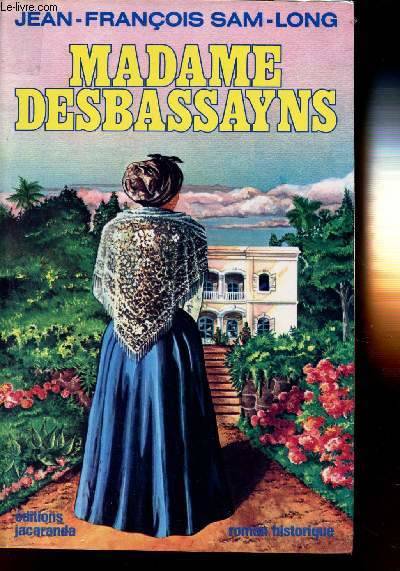
If you read French, local author


Monday, 11 November 2013

Cimetière Marin, St Paul

The Cimetière Marin ("Marine Cemetery") is a historic cemetery on the southern outskirts of the town of St Paul, Reunion.

Entrance to the Marine Cemetery

The cemetery has been in use since 1788, although by the mid-1800s it was already full and another cemetery had to be opened to the north of the town.

old ship's anchor outside the cemetery

Over the years it has seen its share of natural disasters: a tidal wave in August 1883 following the eruption of Krakatoa, and cyclones in 1932, 1948 and 1962. It was renovated during the 1970s.

one of the cannons "guarding" the cemetery entrance

The name refers to its location next to the sea and not to the fact that it is full of sailors (marins in French), although there are quite a few sailors buried here.

general view of the cemetery, looking north-west

General view of the cemetery, looking north

The Ker-Anna was a French three-mast sailing ship which was shipwrecked off the coast of Reunion on 9th December 1894. Eight of the 14 people on board perished, and they are buried in the cemetery.

grave of the Ker-Anna sailors

Probably the cemetery's most famous grave is that of pirate Olivier "La Buse" Levasseur (1688 or 1690-1730), the scourge of the Indian Ocean during the 1720s. Together with John Taylor he perpetrated one of piracy's greatest exploits: the capture of the Portuguese great galleon Nossa Senhora do Cabo ('Our Lady of the Cape') (also known as Virgem Do Cabo ('The Virgin of the Cape')), loaded full of treasures belonging to the Bishop of Goa, (also called the Patriarch of the East Indies), and the Viceroy of Portugal, who were both on board returning home to Lisbon. After being damaged in a storm the ship had anchored off Réunion to undergo repairs. (This incident was later be used by Robert Louis Stevenson in his novel "Treasure Island" where the galleon is referred to as The Viceroy of the Indies in the account given by Long John Silver). La Buse was hanged for piracy in Reunion on 7th July 1730. Legend says that when he stood on the scaffold he had a necklace around his neck containing a cryptogram of 17 lines which he threw in the crowd while exclaiming: "Find my treasure, the one who may understand it!" What became of this necklace is unknown and the hunt for his fabulous treasure continues to motivate treasure hunters to this day.

Olivier "the Buzzard's" Levasseur grave

Another important grave is that of French poet Charles Marie René Leconte de Lisle (1818 – 1894). Born in Reunion he is mainly known, as a writer, by his family name Leconte de Lisle. He took a lead role in the Parnassian movement and also translated works from Ancient Greek. In 1886 he was elected to the Académie française in succession to Victor Hugo. In 1977 his remains were transferred from the Montparnasse cemetery in mainland France to St Paul.

grave of Leconte de Lisle

central alley of the cemetery

The grave of Madame Ombeline Desbassyns can also be found here, transferred from the Chapelle Pointue.

Jubilee cross 
general view, looking inland

"If one day I die
bury me under the Latan Palm.
Its roots will invigorate me
and its fragrance will revive me"

Just outside the cemetery is a tiny public square with the bust of Bishop Alexandre Monnet (1812-1849) "Father of the Blacks". It mentions that he was expelled from the island in 1847 (for his abolitionist views), ironically just one year before slavery was abolished on Reunion.


In 2007 during cyclone Gamede some 18th-century bones were uncovered just outside the cemetery on the black sand beach; they seem to have been part of a former burial area. They were later reburied during an ecumenical ceremony and a monument was erected.