Tuesday, 26 January 2016

Namibia: people, birds, plants

I've just spent almost three weeks in Namibia, a south-west African country which is one of the most sparsely populated regions in the world. 


Here are a few photos of the people, birds and animals that we saw while there.  The population of Namibia comprises 12 major ethnic groups. Half the people come from the Owambo tribe (50%), with other ethnic groups making up a relatively small percentage of the population: Kavango (9%), Herero/Himba (7%), Damara (7%), Capri­vian (4%), Nama (5%), Afrikaner and German (6%), Baster (6.5%), San (1%) and Tswana (0.5%).


One of Namibia's most well-known tribal groups are the Himba, a culturally rich group of nomadic pastoralists who have retained their striking appearance and dress. 


The Himba number approximately 50,000 people, and are closely related to the Herero, yet continue to live much as they have for generations on end.

Himba infant with shaved head; the small crop will later be braided to a plait

Himba women are famous for smearing themselves with otjize paste, a cosmetic mixture of ochre, butterfat and bush herbs, which dyes their skin a burnt-orange colour and cleanses their skin over long periods (necessary due to water scarcity), as well as protecting them from the hot, dry climate and against mosquito insect bites.


We visited a Himba village near Kamanjab.


Smoke from incense, made by burning aromatic herbs and resins, is used as an antimicrobial body cleansing agent, deodorant and fragrant.


In the Kalahari in Eastern Namibia we went on a morning walk with some San bushmen. Although these particular bushmen, like many of their tribesmen and unlike the Himba, no longer live traditionally, knowledge is still being passed on from generation to generation. The San are the original inhabitants of Southern Africa and their presence stretches back as much as 20,000 years. 


The word San is a collective term referring to the traditional groups of hunter-gatherers that occupy sub-Saharan Africa; anthropologists have dubbed the San our ‘genetic Adam’, stating that all living humans can ultimately trace back their lineage to this population group.


We found out how to deal with a scorpion bite, how to catch a porcupine or ostrich, how to recognise certain animal tracks and many other things. Their language is characterised by six click elements; you can hear a sample of it I recorded here.


Namibia’s desert landscape is quite harsh and inhospitable but nevertheless support 706 species of birds, including birds of prey, coastal wildfowl and a range of migratory birds.

Southern masked weaver, near Windhoek

Northern black korhaan? in Etosha National Park

African grey hornbill in Etosha National Park

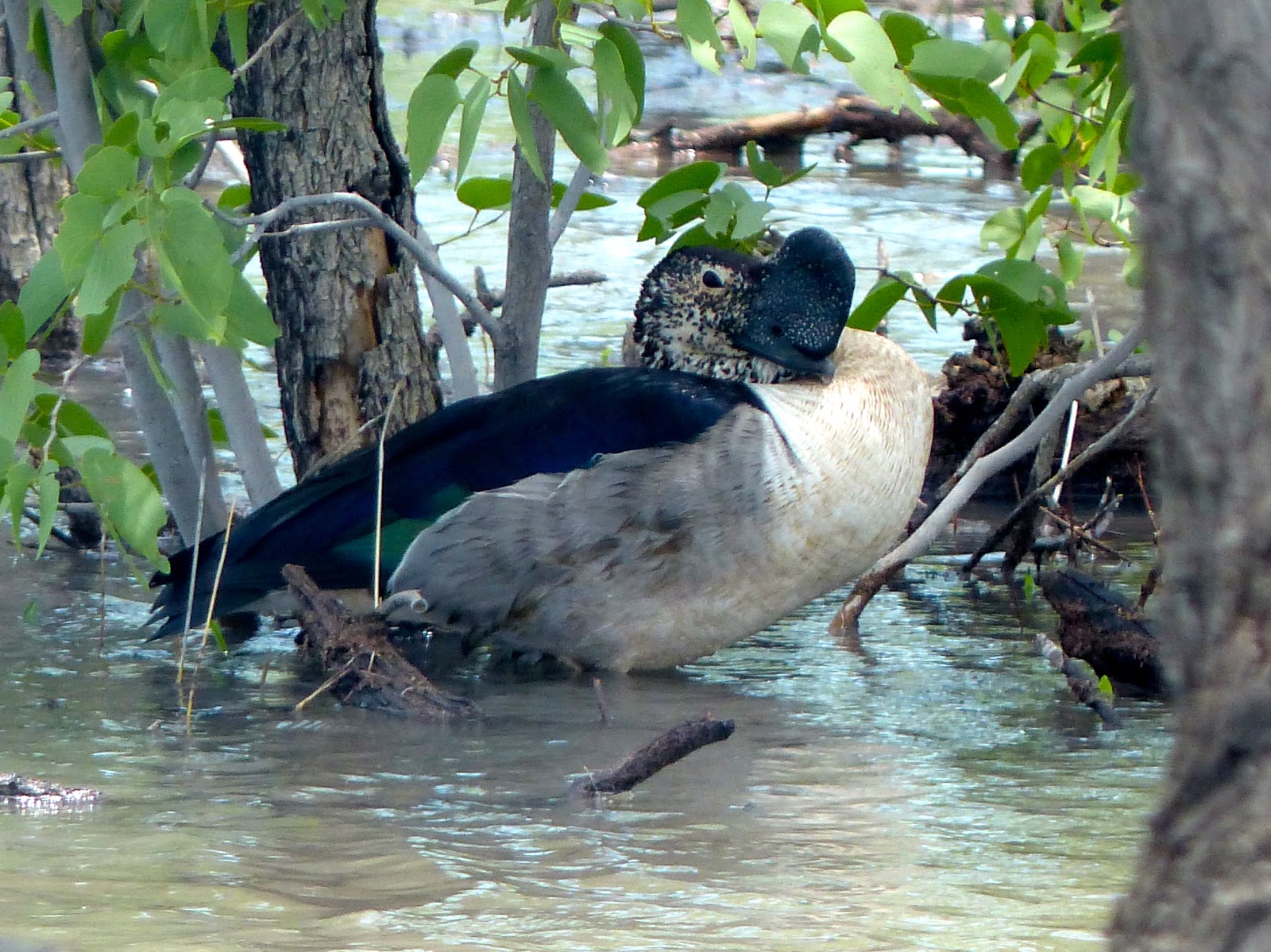
Male comb duck in Etosha National Park

Ostriches roam all over Namibia 

African hoopoe in Etosha National Park

Namaqua sandgrouse, a ground-dwelling bird found in arid regions

unidentified bird

Pelican at Walvis Bay

Flamingoes at Walvis Bay

Flamingoes at Walvis Bay


unidentified bird

more pelicans, Walvis Bay

Southern pale chanting goshawk

Namibia is the driest country south of the Sahara, and plants have had to adapt to the harsh environment.

unidentified plant

Among Namibia’s many botanical curiosities, is the extraordinary Welwitschia mirabilis, which exists only on the gravel plains of the northern Namib Desert. Despite their dishevelled appearance, welwitschias actually have only two long and leathery leaves, which grow from opposite sides of the corklike stem. Over the years, these leaves are darkened in the sun and torn by the wind into tattered strips, causing the plant to resemble a giant wilted lettuce. Pores in the leaves trap moisture, and longer leaves actually water the plant’s own roots by channelling droplets onto the surrounding sand. Welwitschias have a slow growth rate, and it’s believed that the largest ones, whose tangled masses of leaf strips can measure up to 2m across, may have been growing for up to 2000 years! However, most midsized plants are less than 1000 years old. The plants don’t even flower until they’ve been growing for at least 20 years. This longevity is probably only possible because they contain some compounds that are unpalatable to grazing animals.

Welwitschia, only found in Namibia

Flowering cactus


Last but not least is this photo of a quiver tree, a tall branching species of aloe indigenous to Southern Africa and found in Southern Namibia. It gets its name from the San bushmen's practice of hollowing out the tubular branches to form quivers for their arrows.

quiver tree

See also:

Saturday, 23 January 2016

Namibia: places and landscapes

Situated in the subtropics, and flanked by the south Atlantic Ocean, Namibia is famous for its stark beauty. Here are a few photos illustrating this beauty.

sunset at Okaukuejo in Etosha National Park just after a storm;
in the left foreground is a sociable weaver bird nest

The cold Benguela current, which drifts northward from Antarctica, has a massive influence on the climate. Cool, dry air is pushed inland, creating a temperate coastline, and the extreme desert conditions of the Namib


at Kamanjab in northern Damaraland

at a Himba village near Kamanjab

Grootberg Lodge has spectacular views

sunset at Grootberg
roadside stall 

At Twyfelfontein (whose name means 'Doubtful spring') is an extensive and ancient rock art gallery which was declared a Unesco World Heritage Site - Namibia's first - in 2007. Most engravings date back 6,000 years  and were probably the work of ancient San hunter-gatherers. There are 2,500 engravings showing animals, animal tracks and geometric designs as well as a few human figures. Some engravings depict animals that are no longer found in the area – elephants, rhinos, giraffes and lions – and an engraving of a sea lion indicates possible contact with the coast more than 100km away.

Twyfelfontein rock engravings

Twyfelfontein rock engravings

Not far away in an area of open veld is a Petrified Forest scattered with petrified tree trunks up to 45m long and 6m in circumference, which are estimated to be around 260 million years old. The original trees belonged to an ancient group of cone-bearing plants that are known as Gymnospermae. Because of the lack of root or branch remnants, it’s thought that the trunks were transported to the site in a flood from modern-day Congo.

Petrified forest, Damaraland

About 50 individual trees are visible, some half buried in sandstone and many perfectly petrified in silica – complete with bark and tree rings.

Petrified forest, Damaraland

a road to nowhere

The Spitzkoppe are a group of bald granite peaks that rise above the plains about 150km from Swakopmund, and which were the filming location for 2001: A Space Odyssey in The Dawn of man sequences.

part of the Spitzkoppe and Pondoks; campsite in the foreground 

The climate on Namibia's Skeleton Coast is surprisingly temperate (about 15°C lower than further inland) due to the chilly South Atlantic currents, and Cape fur seals thrive in these conditions. The name Skeleton coast apparently derives from the whale and seal bones that once littered the shore from the whaling industry, although the coast also harbours the skeletal remains of many shipwrecks caught by offshore rocks and fog. Cape Cross Seal Reserve is home to a colony of 100,000 seals - one of 25 such colonies (see pictures here). 

whale bones near Cape Cross Seal Reserve

shipwreck and skeleton of a Cape fur seal

Stuck on the South Atlantic coast and surrounded by desert, the town of Swakopmund features German art nouveau architecture, seaside promenades, half-timbered homes and colonial-era buildings. It sells itself as the adventure capital of the region.

Hohenzollern Building, Swakopmund

sandboarding between Swakopmnd and Walvis Bay

The towns of Swakopmund and nearby Walvis Bay are surrounded by the Namib-Naukluft National Park, one of the world's largest national parks. The Park covers 23,000 sq km of arid and semi-arid land, and protects various areas of vast ecological importance in the Namib (the world's oldest desert) and the Naukluft mountain range.

looking across the vista of Moon landscape, Namib-Naukluft National Park

sign marking the Tropic of Capricorn, 23°26′13.9″ south of the equator

Most of Namibia receives less than 10 inches (250 mm) of rain (the entire coastal region has less than 1 inch/25 mm); 80% of this rain falls between October and April. Coming from a place which holds most of the world records for the most amount of rainfall, we had a stark reminder (if we needed it) of the lack of precipitation when passing through the aptly-named settlement of Solitaire. As a comparison, Reunion's world record for rain in 24 hours is 1825mm.

rainfall in Solitaire

Solitaire, a few buildings in central Namibia

Sesriem ('six thongs': the number of joined leather ox-wagon thongs necessary to draw water from the bottom of the nearby gorge) is the gateway and base town for the desert landscape of Sossusvlei, Namibia's major tourist attraction.

Hot-air ballon at sunrise, Sossuvlei, seen from Dune 45

Sossusvlei valley is dotted with enormous sand dunes (up to 300m high) interspersed with vlei (low, open landscapes). Watching the sun rise from the top of Dune 45 is a favourite activity here.

vlei near Dune 45

After leaving the Namib-Naukluft we headed across country to eastern Namibia and the ancient semi-arid Kalahari desert, where we spent the final part of our trip.

Kalahari desert, Namibia

sunset storm, Kalahari


See also:


Saturday, 7 November 2015

Dubai & Abu Dhabi

I first visited Dubai in 2005, when a stopover there en route from Reunion was the easiest way to travel to the Maldives. I didn't like the city much then, but this time after ten days in Oman I had more of a chance to explore and I liked it somewhat better.

cityscape, with Burj Khalifa dominating the skyline

Burj Khalifa with the sun setting behind

close up of the Burj Khalifa

Atlantis Hotel on The Palm artificial island

Tall buildings near Sheikh Zayed Road.
The tallest in this photo is Al Yaqoub Tower (328m),
to the right is the Maze Tower, to the left is Up Tower 

 The Burj Al Arab hotel at Jumeirah Beach bills itself as "the most luxurious hotel in the world".

Burj Al Arab hotel, Jumeirah Beach, Dubai

Dubai Marina

Cayan Tower was opened in 2013 and at 306 metres is the ninth-tallest residential building in the world. 
Cayan Tower, 73 stories

Hoopoe bird

inside the Mall of the Emirates, which has 560 shops

Ski Dubai is a 'ski resort' covering 22,500 square meters and with 3,000 square metres of snow, located inside the enormous shopping centre of Mall of the Emirates.

Ski Dubai, located inside the Mall of the Emirates

sunset over the desert

After two days in Dubai we headed along Sheikh Zayed Road (the longest road in the Emirates at 558.4km) to Abu Dubai.

Looking down Sheikh Zayed Road

Abu Dubai is the largest and wealthiest emirate of the United Arab Emirates and is about 140km from Dubai.

sign at Ferrari World, Yas Island 

view of downtown Abu Dhabi

Heritage Village, Abu Dhabi

View from Emirates Hotel.
The copper building to the right is the Millennium Bab al Qasr hotel.
The buildings to the left are Etihad Towers & the Regent Emirates Pearl.

Emirates Palace luxury hotel, Abu Dhabi

Sheikh Zayed Mosque


You might also like: